
Every operator knows what crude oil production is. Fewer fully account for the gap between what the production separator measures and what the pipeline custody transfer meter confirms, a gap created by the invisible phenomenon of crude oil shrinkage.
Shrinkage is the loss of crude oil volume as light hydrocarbon components evaporate, flash, or are stripped from the crude between the production separator and the point of sale. It is not a measurement error. It is real hydrocarbon loss, propane, butane, pentane, and natural gasoline that were part of the crude oil stream at the wellhead and are no longer present when the crude is measured at the pipeline meter.
Understanding what causes shrinkage, how large it can be for shale crude, and what operators can do to not only stop the loss but recover that volume as higher-value NGL product is essential for any production manager or commercial team focused on maximizing realized crude oil value.
What Is Crude Oil Shrinkage?
Crude oil shrinkage is the reduction in crude liquid volume that occurs as the crude moves from production conditions (elevated pressure, separator temperature) to storage and pipeline conditions (atmospheric pressure, ambient temperature, and sometimes elevated storage temperature).
The mechanism is thermodynamic: crude oil produced from an oil reservoir is a complex mixture of hydrocarbons ranging from methane through heavy fractions. Under reservoir pressure and temperature, many lighter components (propane, butane, pentane) remain dissolved in the liquid crude phase.
As pressure decreases across production separators, and as temperature changes between the separator and storage, these lighter components progressively come out of solution, transitioning from dissolved liquid to vapor phase.
The vapor that is released is not crude oil. It is gas. The crude loses volume.
The Specific Components Responsible for Shrinkage
Not all hydrocarbon components in crude oil contribute equally to shrinkage.
Methane and ethane, At normal separator conditions, these components largely flash out of solution in the first-stage high-pressure separator. They are captured as associated gas in the gas separation system. Their contribution to storage tank shrinkage is typically small.
Propane (C3), Propane has a boiling point of -44°F. At atmospheric pressure and any normal ambient temperature, propane is a vapor. Propane dissolved in crude that is not fully separated under pressure will evaporate from storage tanks, contribute to elevated RVP, and be lost to the atmosphere unless captured.
Butane (C4), Normal butane (boiling point 31°F) and isobutane (boiling point 11°F) similarly evaporate from crude at atmospheric conditions. Warm storage tank temperatures accelerate this evaporation.
Pentanes (C5), Natural pentane boils at 97°F. In warm climates or heated tank batteries, pentane evaporation from crude is significant and continuous. Isopentane (82°F boiling point) is more volatile still.
Natural gasoline (C6+), The heavy end of the NGL spectrum, natural gasoline (hexanes, heptanes) has much lower vapor pressure but still contributes to evaporative losses under warm conditions.
It is propane, butane, and pentane that cause the majority of field-measurable crude oil shrinkage at upstream facilities.
The Magnitude of Shrinkage in Shale Crude Operations
Shrinkage magnitude depends directly on crude composition, specifically how much C3–C5 content was dissolved in the crude under separator conditions.
For conventional crude oil from older, lower-GOR formations, shrinkage between the separator and pipeline meter might be 0.5–1.5%.
For modern shale crude from high-GOR wells in the Permian Basin, Bakken, or DJ Basin, shrinkage can be dramatically higher. These formations produce crude with elevated light-end content, often 6–15% combined C3–C5 by volume. As those components flash and evaporate across the handling system:
- A 10,000 barrel per day facility with 5% shrinkage loses 500 barrels per day at the custody transfer meter
- At $70/bbl realized crude price, that 500 bbl/day loss is $35,000 per day, over $12.7 million annually, in crude value that was never captured
These numbers make crude oil shrinkage one of the most financially significant but least discussed production optimization opportunities in shale operations.
Where Shrinkage Occurs in the Production System
Shrinkage is not a single event, it is a distributed process that occurs at multiple points between the wellhead and the pipeline meter.
At the Low-Pressure Separator
A properly designed three-stage separator removes progressively more light ends at each lower-pressure stage. But separator efficiency depends on residence time, gas handling capacity, and operating conditions that may not consistently capture all the light ends that flash during a high-production, high-GOR processing event.
Light ends not removed in the separator continue to the crude storage system.
In Crude Storage Tanks
Atmospheric crude storage tanks are where most of the C3–C5 shrinkage occurs. As crude enters the tank at near-atmospheric pressure, any remaining dissolved propane and butane immediately begin to flash to vapor in the tank vapor space. This vapor exits through the tank thief hatch, pressure-vacuum vent, or tank vapor collection manifold.
The tank is a controlled environment for this phase separation, but the vapor that escapes uncontrolled (directly to atmosphere or through an open vent) represents lost hydrocarbon value that was never metered.
In Transfer Pipelines and Lines
Hot crude in flow lines loses light ends to vapor phase continuously. At high ambient temperatures or when crude is heated (in insulated or heat-traced pipelines), evaporation rates increase.
At the Pipeline Metering Point
The pipeline custody transfer meter measures the crude that arrives, which is the crude minus whatever light ends were lost between the wellhead and the meter. The pipeline company does not credit the operator for the vapor that escaped from the tank vent.
The Relationship Between Shrinkage and RVP Violations
There is a direct connection between crude shrinkage and crude oil RVP (Reid Vapor Pressure) specification violations.
Crude that still contains significant dissolved C3–C5 fractions has high RVP. When it reaches the pipeline custody transfer meter, the pipeline’s RVP specification may be violated, triggering rejection or price penalties.
Crude that has lost those same fractions to uncontrolled evaporation (shrinkage) has lower RVP, potentially within specification. But the operator has lost the volume and value of those fractions without capturing them.
This is the fundamental problem with allowing uncontrolled shrinkage as an RVP compliance strategy: it achieves spec compliance through value destruction. The operator is essentially giving away the most valuable components of the crude in order to meet pipeline specifications.
The correct solution is controlled stabilization: remove the light ends intentionally, at conditions where they can be captured as liquid NGL rather than lost as vapor, and deliver both on-spec crude and a metered NGL stream to separate custody transfer.
How Crude Stabilization Captures the Value of Shrinkage
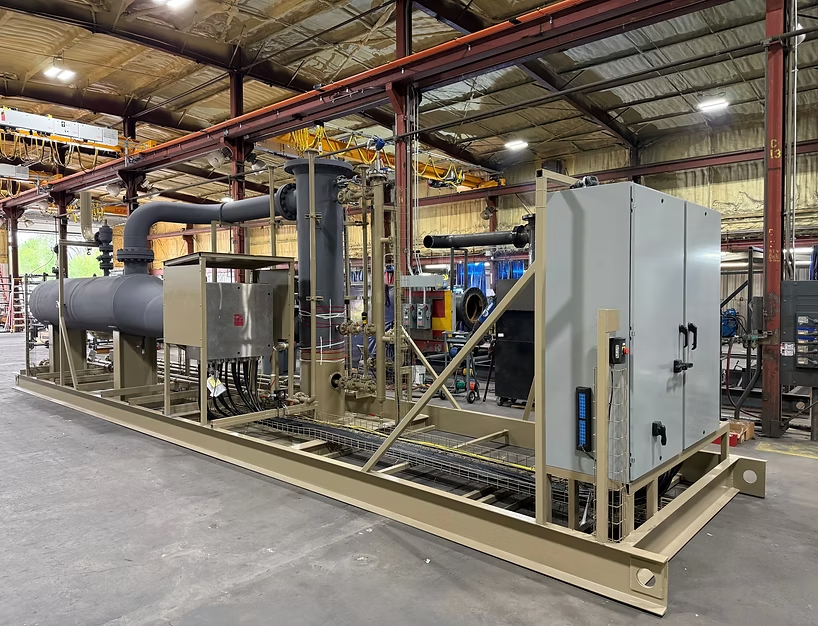
A crude oil stabilization system, Pioneer Energy’s VPT-500, VPT-2500, or Titan System, takes the light ends that would otherwise be lost as uncontrolled shrinkage and captures them as a productive, saleable NGL liquid.
The process:
- Crude enters the VPT from production separators or storage tanks at above-atmospheric pressure
- Controlled pressure reduction under conditions that favor condensate recovery, not vapor loss, strips the C3–C5 fractions
- The vapor stream from the VPT contains propane, butane, and pentane fractions in high concentration
- The Pegasus LP (in the Titan System configuration) refrigerates the vapor stream, condensing C3+ fractions as liquid Y-grade NGL
- The NGL liquid is collected, metered, and dispatched for truck-out or pipeline injection
- The stabilized crude exits at on-spec RVP, ready for pipeline acceptance without penalties
The key distinction: instead of losing 500 barrels per day equivalent of C3–C5 to uncontrolled tank evaporation and RVP compliance blending, the operator captures those hydrocarbons as Y-grade NGL liquid at full NGL market value.
The Value Conversion: Shrinkage to NGL Revenue
The financial transformation from uncontrolled shrinkage to controlled NGL recovery can be modeled using actual production data.
Example: A facility processes 10,000 bbl/day of crude oil with 8% C3–C5 content. Currently, approximately half of those light ends (4% of crude volume, or 400 bbl/day equivalent) are lost to uncontrolled evaporation and blending to meet RVP.
| Scenario | Light-End Handling | Daily Value |
|---|---|---|
| Current (uncontrolled) | Lost to vapor / blended away | $0 direct capture |
| With stabilization | Captured as Y-grade NGL at $38/bbl eq. | +$15,200/day |
The $15,200/day improvement, approximately $5.5 million annually, does not require producing a single additional barrel of crude. It is value that already exists in the production stream, currently being destroyed by uncontrolled shrinkage and suboptimal handling.
Conclusion
Crude oil shrinkage is not a measurement artifact or an unavoidable fact of production operations. It is real hydrocarbon loss, light components that were in the crude at the wellhead and are not present at the pipeline meter, that can be quantified, reduced, and converted into NGL revenue.
For shale oil operators producing high-GOR, light crude with significant C3–C5 content, controlled stabilization using Pioneer Energy’s VPT and Titan systems is the direct path from current shrinkage losses to captured NGL value, simultaneously solving the RVP compliance challenge and converting what was a loss into a new revenue stream.
Contact Pioneer Energy for a complimentary shrinkage and NGL recovery evaluation at your facility.
Frequently Asked Questions
What is crude oil shrinkage?
Crude oil shrinkage is the reduction in crude oil volume as light hydrocarbon components (propane, butane, pentane, natural gasoline) evaporate or flash from the crude between the production separator and the pipeline custody transfer meter. These light ends come out of solution as pressure decreases and temperature changes, reducing both the volume and vapor pressure of the crude.
What causes crude oil to shrink?
Crude oil shrinks because dissolved light hydrocarbons come out of solution as the crude moves from high-pressure separator conditions to lower-pressure atmospheric storage and pipeline conditions. Elevated tank temperatures accelerate this process. The primary contributors are propane, butane, and pentane fractions.
How much crude oil volume can be lost to shrinkage?
For high-GOR shale crude, volume losses from wellhead to pipeline meter can range from 2–8% or more. On a 10,000 barrel per day facility, 5% shrinkage represents 500 barrels per day of crude value never captured at the custody transfer meter.
How does crude oil stabilization prevent shrinkage?
Crude oil stabilization deliberately removes light ends from crude under controlled conditions where they are captured as Y-grade NGL liquid rather than lost as vapor. By recovering these components intentionally, stabilization prevents them from being lost as uncontrolled shrinkage through tank venting or measurement discrepancies.
What is the value of light ends lost to crude shrinkage?
Light ends (propane, butane, natural gasoline) lost to shrinkage are vaporized at crude value or less, when they could be captured as Y-grade NGL at a significant premium. Recovering 200–500 barrels per day equivalent of NGL from what was previously shrinkage loss can add $1–$5 million per year in realized production value.
What Pioneer Energy technology prevents crude shrinkage?
Pioneer Energy’s VPT-500 and VPT-2500 vapor pressure treaters, and the integrated Titan System, stabilize crude to pipeline RVP specification while capturing removed light ends as Y-grade NGL liquid, converting shrinkage loss into a metered, saleable product.