
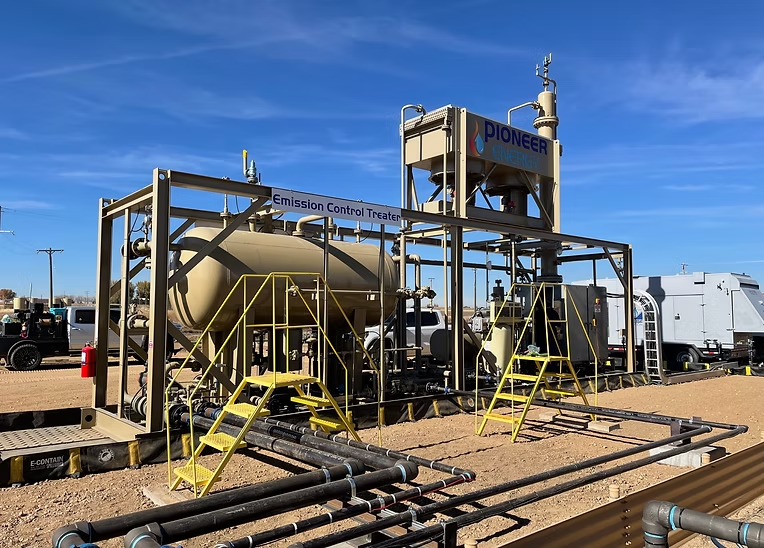
Produced crude oil leaving a wellsite is rarely ready for sale, transport, or pipeline injection as-is. It carries dissolved light hydrocarbons, methane, ethane, propane, and butanes, that cause excessive vapor pressure, creating safety risks, transportation complications, and rejected pipeline tenders.
Crude oil stabilization solves this problem at the source.
By removing volatile hydrocarbons before crude reaches the tank battery, field stabilization systems reduce Reid Vapor Pressure (RVP), improve crude quality, and capture valuable hydrocarbon byproducts that would otherwise be lost to flaring or venting.
For many upstream operators, field stabilization is one of the highest-return investments available on a producing property.
What Is Crude Oil Stabilization?
Crude oil stabilization is a field processing operation that removes light hydrocarbon components from produced crude oil in order to reduce its vapor pressure to acceptable levels for safe storage, trucking, or pipeline transport.
Unstabilized crude oil contains significant quantities of dissolved gases. When these volatile components remain in the crude, they:
- Create excessive vapor pressure in storage tanks
- Cause tanks to vent or release vapors to atmosphere
- Generate safety hazards during loading and transport
- Cause crude to fail pipeline vapor pressure specifications
- Increase emissions and regulatory liability
Stabilization strips these light ends out of the crude stream, leaving a stabilized product that can be handled safely and sold at full value.
What Is Reid Vapor Pressure (RVP)?
Reid Vapor Pressure (RVP) is the standard industry measurement used to characterize crude oil volatility. It measures the pressure exerted by vapor in a closed container at 100°F (37.8°C).
Crude oil with high RVP:
- Contains more dissolved light hydrocarbons
- Has higher evaporative losses during storage
- Creates more dangerous conditions during truck loading
- Often fails pipeline quality specifications
Most crude oil pipelines and trucking operations have maximum RVP limits that produced crude must meet. Crude that exceeds these thresholds may be rejected entirely or accepted at a significant price discount.
Field stabilization brings RVP into compliance before custody transfer, protecting both value and operations.
How Does Crude Oil Stabilization Work?
Crude oil stabilization systems use a combination of heat, pressure reduction, and separation to remove volatile components from the crude stream.
Stage 1: Crude Inlet Heating
Incoming crude is heated to mobilize dissolved light hydrocarbons and encourage flash separation.
Stage 2: Flash Separation
As pressure drops across the stabilizer, dissolved gases flash out of solution. Light hydrocarbons, primarily methane, ethane, propane, and butanes, separate from the liquid crude phase.
Stage 3: Vapor Recovery
Rather than venting or flaring the recovered vapors, modern stabilization systems capture this hydrocarbon stream for on-site fuel use, pipeline injection, or processing into Y-grade NGLs with field gas conditioning equipment.
Stage 4: Stabilized Crude Output
The stabilized crude exits the system with reduced RVP, meeting pipeline or trucking specifications and ready for sale at full market value.
What Is a Vapor Pressure Treater?
A Vapor Pressure Treater (VPT) is a compact, modular crude oil stabilization system designed for field deployment at upstream production facilities.
Unlike large refinery-scale stabilization towers, field VPTs are skid-mounted for rapid deployment, sized for upstream flow rates, and engineered to operate in remote oilfield environments with variable inlet compositions.
Pioneer Energy’s Vapor Pressure Treater product line includes two primary configurations:
VPT-500, designed for facilities producing up to 500 barrels per day of stabilized crude output.
VPT-2500, designed for higher-volume facilities requiring up to 2,500 barrels per day of stabilized crude output.
Both systems are fabricated and tested before field delivery, minimizing installation time and field construction requirements.
Why Does Crude Oil Stabilization Matter for Operators?
The financial case for crude oil stabilization is straightforward.
Higher Realized Crude Prices
Stabilized crude that meets vapor pressure specifications sells at full market value. Unstabilized crude may be rejected outright or penalized heavily in price.
Reduced Trucking Risk
Hauling unstabilized crude creates safety risks for drivers and exposes operators to liability. Stabilized crude is safer to load, transport, and handle.
Lower Tank Emissions
When unstabilized crude enters a tank, it releases vapors continuously. Stabilization reduces these emissions at the source, lowering the regulatory exposure from tank-side venting and reducing VOC emissions significantly.
Captured Hydrocarbon Value
The light hydrocarbons removed during stabilization are not waste, they are valuable hydrocarbon products. When paired with field gas conditioning equipment, these vapors can be recovered as usable fuel gas or processed into Y-grade NGLs.
Regulatory Compliance
Increasingly strict environmental regulations target tank-side emissions from upstream crude storage. Stabilization systems that reduce tank vapor generation help operators maintain compliance proactively.
Crude Stabilization vs. Crude Conditioning: What Is the Difference?
The terms crude oil stabilization and crude oil conditioning are often used interchangeably, but they describe slightly different emphases.
Stabilization focuses specifically on reducing vapor pressure to meet transport and pipeline specifications.
Conditioning is a broader term that includes stabilization but may also refer to treating crude to remove water, sediment, hydrogen sulfide, or other contaminants that affect quality and marketability.
How Stabilization Connects to Field Gas Conditioning
Crude oil stabilization and field gas conditioning work together as a complementary system on many upstream properties.
When a VPT stabilizes crude, it generates a vapor stream containing valuable hydrocarbons. Rather than flaring or venting this stream, operators can route it to Pioneer Energy’s Pegasus field gas conditioning systems for further processing.
The result is a fully integrated approach where the VPT stabilizes crude and captures vapors, the Pegasus system conditions the vapor stream, residue gas becomes reliable fuel for generation or compression, and heavy hydrocarbons are recovered as Y-grade NGLs.
This integration maximizes the value of every hydrocarbon molecule produced at the wellsite.
Common Challenges in Field Crude Stabilization
Field crude stabilization must handle conditions that would be unusual in a controlled refinery environment:
Variable inlet composition, crude composition changes as reservoirs deplete or new wells come online.
Paraffin deposition, light crude streams can deposit paraffin wax in processing equipment over time.
Intermittent flow, upstream production is rarely constant. Stabilization systems must handle slug flow and variable throughput.
Temperature extremes, field equipment operates across a wide range of ambient temperatures, from desert heat to mountain cold.
Pioneer Energy engineers these operational realities into the VPT product family through extensive field experience and continuous product development.
Evaluating a Crude Stabilization Project
Before selecting and sizing a stabilization system, engineers typically evaluate crude flow rate and composition, current and target RVP values, available inlet pressure and temperature, associated vapor composition and volume, and downstream market specifications.
Pioneer Energy offers a complimentary analysis using your crude and gas composition data with proprietary equipment modeling to support project economics evaluation before any capital commitment.
Conclusion
Crude oil stabilization is one of the most impactful improvements available to upstream operators looking to increase realized crude value, reduce emissions, and improve site safety.
By removing volatile hydrocarbons at the wellsite through a field-deployable Vapor Pressure Treater, producers deliver pipeline-quality crude, lower their tank emissions profile, and capture a hydrocarbon vapor stream that can be converted into additional revenue.
When integrated with Pioneer Energy’s field gas conditioning technology, crude stabilization becomes part of a complete oilfield hydrocarbon optimization strategy, recovering more value from every barrel and every cubic foot produced.
Frequently Asked Questions
What is crude oil stabilization?
Crude oil stabilization is a field processing operation that removes dissolved light hydrocarbons from produced crude oil, reducing its vapor pressure so it can be safely stored, transported, and sold at full market value.
What does RVP mean in crude oil?
RVP stands for Reid Vapor Pressure. It measures crude oil volatility at 100°F. High RVP crude contains more dissolved light hydrocarbons and may fail pipeline or trucking specifications without treatment.
What is a Vapor Pressure Treater?
A Vapor Pressure Treater (VPT) is a compact, skid-mounted crude oil stabilization system designed for deployment at upstream oil production facilities. Pioneer Energy manufactures VPT systems in 500 BPD and 2,500 BPD configurations.
Why does unstabilized crude get rejected by pipelines?
Pipeline and trucking operators enforce maximum RVP limits for safety and quality reasons. Crude that exceeds these limits poses handling risks and may contaminate pipeline batches, resulting in rejection or significant price penalties.
Can the vapors from crude stabilization be recovered?
Yes. Vapors removed during crude stabilization contain valuable hydrocarbons. These can be used as fuel gas on-site, injected into gas gathering systems, or further processed into Y-grade NGLs using field gas conditioning systems such as Pioneer Energy’s Pegasus product family.
How is crude stabilization different from crude conditioning?
Stabilization specifically targets vapor pressure reduction. Conditioning is a broader term that includes stabilization plus removal of water, sediment, H2S, or other contaminants affecting crude quality and marketability.
How much crude can a Vapor Pressure Treater process?
Pioneer Energy’s VPT-500 processes up to 500 barrels per day of stabilized crude output, while the VPT-2500 handles up to 2,500 barrels per day. Both are skid-mounted systems designed for field deployment.