
Crude oil leaving a production site is not a finished product. Before it can be transported by pipeline, terminal, or truck, and before it can command full market value, it must meet a specific set of quality requirements.
These requirements, defined by pipeline operators, terminal operators, and trading counterparties, govern the crude’s physical and chemical properties. Too much water, too much sediment, too much vapor pressure, or the wrong gravity band, and the crude will be rejected at the meter or subject to price penalties that can represent hundreds of thousands of dollars per month in lost value.
Understanding crude oil pipeline specifications, what causes crude to fall out of specification, and how stabilization and treatment processes bring crude into compliance is essential knowledge for production engineers, facility managers, and commercial teams at upstream and midstream operators.
The Key Crude Oil Pipeline Specifications
Reid Vapor Pressure (RVP)
RVP is one of the most frequently cited crude pipeline specs and the one most likely to be violated by crude from oil-rich, high-GOR formations.
Reid Vapor Pressure measures the pressure that a liquid exerts at 100°F (38°C) in a sealed container. A high RVP indicates that the crude contains significant quantities of light, volatile hydrocarbons, propane, butane, and pentane fractions, that want to flash into vapor at moderate temperatures.
Typical crude oil pipeline RVP requirements:
| Pipeline / Market | Typical RVP Limit |
|---|---|
| Major U.S. crude pipelines (Permian takeaway) | 9.0–13.5 psi |
| Rail terminal specifications | 9.0–11.5 psi |
| Seasonal (summer) requirements | 7.0–9.5 psi in some jurisdictions |
| Offshore loading | Often 10.0–12.0 psi |
When crude exceeds these limits, pipeline operators reject it or impose price penalties. Operators are sometimes forced to blend high-RVP crude with lower-RVP crude to bring the blend within specification, but this blending strategy destroys value by diluting the light-end content rather than recovering it as NGL product.
Basic Sediment and Water (BS&W)
BS&W measures the non-hydrocarbon content of crude oil, free water, emulsified water, and suspended sediment carried along with the oil from the production site.
Most pipeline specifications require BS&W of 0.5% or less, with some terminals accepting up to 1.0%. Crude exceeding these limits creates multiple problems downstream:
- Corrosion of pipeline infrastructure and storage tanks
- Measurement inaccuracy at fiscal custody transfer points (the pipeline is paying for water, not oil)
- Processing problems at refineries and terminals
- Increased waste water disposal volumes
BS&W compliance is primarily addressed through production separators (two-phase and three-phase), heater treaters (heat + chemical demulsification), and wash tanks. Proper separator operation upstream is the first line of defense against BS&W violations.
API Gravity
API gravity is an inverse density measure, higher API numbers indicate lighter, less dense crude. Crude oil is typically categorized as:
- Heavy crude: API < 22°
- Medium crude: API 22–31°
- Light crude: API 32–39°
- Extra light crude: API 40°+
Pipeline operators band crude by API gravity because different gravity ranges have different refinery processing requirements and market values. A pipeline that accepts 35–42° API crude may reject crude that falls outside that band.
Important note on RVP and API interaction: As crude oil fields mature and produce more associated gas (increasing GOR), the crude itself typically becomes lighter (higher API) and higher in RVP. This is a common trajectory in shale oil plays, early-life wells produce medium-gravity crude; late-life wells from the same formation produce lighter crude with significantly higher RVP from elevated light-end content. This is the mechanism behind the NGL-to-oil ratio challenge addressed by Pioneer Energy’s Titan System.
H₂S Content
Some crude oil streams contain dissolved hydrogen sulfide. Pipeline specifications typically limit H₂S in crude oil to less than 10–50 ppm depending on the pipeline.
H₂S causes accelerated corrosion of steel infrastructure and creates safety hazards during crude handling and processing. Crude containing H₂S above specification may require sweetening treatment before pipeline acceptance.
Gravity and Viscosity Banding
Beyond API gravity, some pipelines have minimum gravity requirements (to prevent excessively heavy crude from affecting downstream operations) or viscosity limits (relevant for heavy crude that may solidify or require diluent for pipeline movement).
Why Crude Falls Out of RVP Specification
The most common and commercially significant pipeline quality problem in modern shale oil operations is RVP violation, crude that exceeds the vapor pressure limit at the pipeline metering point.
The primary driver is the light-end content of the crude: specifically the concentrations of propane (C3), isobutane (iC4), normal butane (nC4), isopentane (iC5), and normal pentane (nC5) fractions.
These components are produced dissolved in the crude oil under reservoir pressure. At surface, they remain dissolved in the crude at normal operating temperatures, but at warmer temperatures (and especially at the standardized 100°F test condition for RVP measurement), they exert significant vapor pressure.
Several production trends have worsened this challenge:
Higher GOR wells, As shale wells age, GOR typically increases. More associated gas production means more light hydrocarbons being produced alongside the oil.
Elevated C3+ in crude, In some formations, the C3-C5 fractions in crude have increased as operators drain more of the reservoir. The crude is not only lighter but richer in the specific components that drive RVP.
Inadequate separation, Three-phase separators that are not properly sized or maintained for current throughput and composition conditions may not remove sufficient light ends before the crude enters storage and measurement.
Atmospheric storage tanks, Crude held in atmospheric tanks continues to lose light ends to the atmosphere (reducing RVP naturally), but this is a waste of hydrocarbon value and a regulated emissions source.
The Business Case for Crude Stabilization
The conventional response to high-RVP crude is blending, mixing the out-of-spec crude with heavier, lower-RVP crude from other wells or other formations to bring the blend within specification.
The problem with blending: it destroys value by using the heavy crude’s low RVP to absorb the light crude’s excess light ends, rather than capturing those light ends separately as NGL product.
Crude stabilization is the alternative, and the economically superior one.
A crude stabilization system actively removes the light-end components (C3-C5 fractions) from the crude before it reaches the pipeline meter. The stabilized crude reliably meets RVP specification. The removed components are captured as Y-grade NGL liquid.
The Y-grade NGL stream, propane, butane, and natural gasoline, typically trades at a significant premium to crude oil or natural gas on a BTU-equivalent basis. Depending on NGL market conditions, operators capturing this stream rather than blending it away can realize $8–$20 per barrel of equivalent oil production in additional revenue.
Production Separation vs. Dedicated Crude Stabilization
The first line of RVP management is proper production separation. A well-designed, properly operated three-stage separator system removes a significant portion of the light ends during normal gas-liquid separation.
But production separators are not designed or operated to achieve pipeline-spec RVP control. They separate phases at operating pressure and temperature, not at the specific conditions needed to guarantee RVP compliance at custody transfer.
When production separator performance is insufficient, because GOR has increased, throughput has grown beyond design, or the crude composition has shifted, dedicated vapor pressure treatment becomes the required solution.
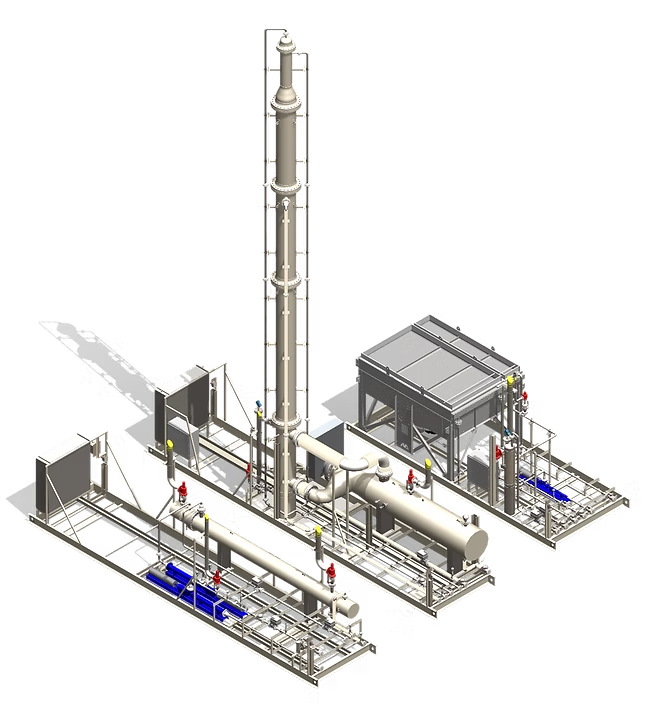
Pioneer Energy’s Vapor Pressure Treater (VPT) systems are designed specifically for this role: processing crude oil from production separators or storage tanks to remove sufficient light ends to guarantee pipeline-spec RVP at the custody transfer meter.
Pioneer Energy’s Crude Stabilization Technology
VPT-500
The VPT-500 is Pioneer Energy’s smaller-format vapor pressure treater, designed for upstream production facilities processing moderate crude volumes. It treats crude to pipeline RVP specification while generating a vapor stream that can be captured for NGL recovery or fuel use.
VPT-2500
The VPT-2500 is Pioneer’s high-capacity vapor pressure treater, handling larger throughputs at central gathering facilities and midstream operations. It forms the crude processing core of Pioneer’s Titan System.
The Titan System: Stabilization + NGL Recovery
Pioneer Energy’s Titan System combines the VPT-2500 with the Pegasus LP mid-range conditioning system in an integrated, skid-mounted package. The Titan System:
- Receives crude from production separators or storage tanks
- Strips light ends in the VPT-2500, reducing RVP to pipeline specification
- Conditions the vapor stream in the Pegasus LP, refrigerating it to condense C3+ fractions as Y-grade NGL liquid
- Returns residue gas to fuel or gathering
- Delivers NGL liquid for truck-out or pipeline injection
The Titan System is also deployed as a bolt-on debottlenecking solution for existing midstream NGL stabilization plants, discussed in detail in our article on NGL stabilization expansion.
Practical Steps to Evaluate Crude Pipeline Specification Compliance
If your crude is approaching or exceeding RVP limits, a structured evaluation typically follows this path:
1. Characterize the crude, Obtain a current compositional analysis (extended analysis including C1–C10+ fractions) and calculate RVP from composition rather than relying solely on laboratory RVP measurement.
2. Model the separation system, Use process simulation to determine how much RVP reduction is achievable from optimizing existing separation conditions (pressure, temperature, number of stages).
3. Identify the gap, Determine the remaining RVP reduction needed beyond what optimized separation provides.
4. Evaluate stabilization options, Model the VPT or Titan System to confirm achievable RVP, NGL yield, and revenue from the captured light-end stream.
5. Calculate project economics, Compare stabilization system capital and operating cost against blending cost, price penalties, and NGL recovery value.
Pioneer Energy’s engineering team routinely performs steps 1–5 as part of a complimentary project evaluation for operators facing RVP compliance challenges.
Conclusion
Meeting crude oil pipeline specifications is not optional, it is a prerequisite for selling oil. The most impactful specification in modern shale oil operations is RVP, driven by the elevated light-end content of crude from high-GOR wells.
The economically optimal response to RVP challenges is stabilization: remove the light ends, stabilize the crude to specification, and capture the removed fractions as Y-grade NGL product. This approach achieves compliance while generating additional revenue from components that blending strategies simply destroy.
Pioneer Energy’s VPT and Titan System solutions are designed for exactly this application, modular, skid-mounted, rapidly deployable, and engineered to deliver pipeline-spec crude and NGL recovery value simultaneously.
Contact Pioneer Energy to evaluate your crude specifications and the economics of stabilization at your facility.
Frequently Asked Questions
What are crude oil pipeline specifications?
Crude oil pipeline specifications are the quality requirements that crude must meet before a pipeline or terminal will accept it for transportation. Key parameters include Reid Vapor Pressure, Basic Sediment and Water, API gravity, and H2S content. Meeting these specs is required for crude oil to be saleable.
What is RVP in crude oil?
RVP stands for Reid Vapor Pressure, a measure of how volatile a crude oil is, specifically the pressure its light hydrocarbon components exert at 100°F. High-RVP crude contains large amounts of propane, butane, and pentane that make it volatile and potentially out of specification for pipeline acceptance.
What is a typical RVP limit for crude oil pipelines?
Most crude oil pipeline specifications require an RVP of 9.0–13.5 psi or lower. In warmer months or in basins with tighter requirements, limits may be as low as 7.0–9.0 psi. Crude exceeding the RVP limit will be rejected or subject to price penalties.
What is BS&W in crude oil?
BS&W stands for Basic Sediment and Water, the water, sediment, and emulsion content suspended in crude oil. Pipeline specifications typically require BS&W of 0.5% or less. High-BS&W crude creates corrosion, measurement inaccuracy, and processing problems downstream.
What is crude oil stabilization?
Crude oil stabilization is the process of removing light hydrocarbon components from produced crude to reduce vapor pressure to pipeline specification. Stabilization produces stable, on-spec crude while generating a light hydrocarbon vapor stream that can be captured and processed for NGL recovery.
What Pioneer Energy systems stabilize crude to pipeline specification?
Pioneer Energy’s Vapor Pressure Treater (VPT) systems, the VPT-500 and VPT-2500, are modular, skid-mounted crude stabilization systems. The Titan System (VPT-2500 + Pegasus LP) handles both stabilization and NGL recovery in an integrated package for higher-throughput upstream and midstream applications.