
Natural gas liquids have traditionally been a product of large-scale gas processing plants. A gas producer routes rich gas into a regional processing facility, the plant fractionates ethane, propane, butane, and natural gasoline out of the gas stream, and the producer receives NGL revenues minus processing fees.
That model works well for producers with large gas volumes connected to pipeline gathering infrastructure. But it leaves out a substantial portion of the oil and gas industry, operators producing associated gas in oil-rich formations, at remote locations without gathering pipelines, or in volumes too small to justify long-term plant processing agreements.
For these operators, field NGL recovery offers a different path: extract the liquids value from the gas stream at the wellsite, truck the recovered Y-grade NGLs directly to market, and use the leaner residue gas as on-site fuel.
The economics are increasingly compelling, and modern modular conditioning systems have made this approach practical at field scale.
What Are Natural Gas Liquids?
Natural gas liquids (NGLs) are hydrocarbon components that are present as gas in reservoir conditions but can be recovered as liquids through surface processing.
The main NGL components are:
| Component | Carbon Number | Primary Use |
|---|---|---|
| Ethane | C2 | Petrochemical feedstock |
| Propane | C3 | Heating, agricultural, industrial fuel |
| Butane / Isobutane | C4 | Blending, petrochemicals, alkylation |
| Natural Gasoline (C5+) | C5+ | Gasoline blending, solvent |
NGLs are recovered both from associated gas produced with crude oil and from wet natural gas streams from dedicated gas wells.
What Is Y-Grade NGL?
Y-grade NGL (also called raw mix or mixed NGL) is an unfractionated mixture of the recovered liquid components, ethane, propane, butane, isobutane, and natural gasoline, in proportions that reflect the source gas composition.
Y-grade is the form in which most field NGL recovery systems deliver their product. It is:
- Liquid at pipeline or storage pressure
- Trucked in tanker wagons to fractionation facilities
- Priced as a blend based on the proportional value of its individual components
- Readily marketed through commodity trading channels
The value of Y-grade NGL varies with the composition. A propane-rich Y-grade trades closer to propane pricing; an ethane-heavy mix trades at a discount. Field operators work with NGL marketers to establish pricing based on sample analysis.
Why Is There NGL Value in Associated Gas?
Associated gas from oil production, the gas that comes out of solution when crude oil reaches surface pressure, contains a significant proportion of heavier hydrocarbons simply because it was dissolved in crude oil.
Light crude from shallow formations often carries 5–15 gallons of NGL per Mscf of gas. Rich associated gas from oil-bearing formations can contain even higher liquid content. When this gas is simply burned in a flare or compressed into a pipeline system and sold at natural gas pricing, those NGL components are effectively sold at a significant discount relative to their actual market value.
Field NGL recovery captures the value gap between natural gas pricing and liquids pricing for these heavy components.
How Does Field NGL Recovery Work?
Field NGL recovery systems extract heavy hydrocarbon components from the gas stream through cooling, pressure manipulation, or absorption, causing the heavier molecules to condense from vapor phase into liquid phase.
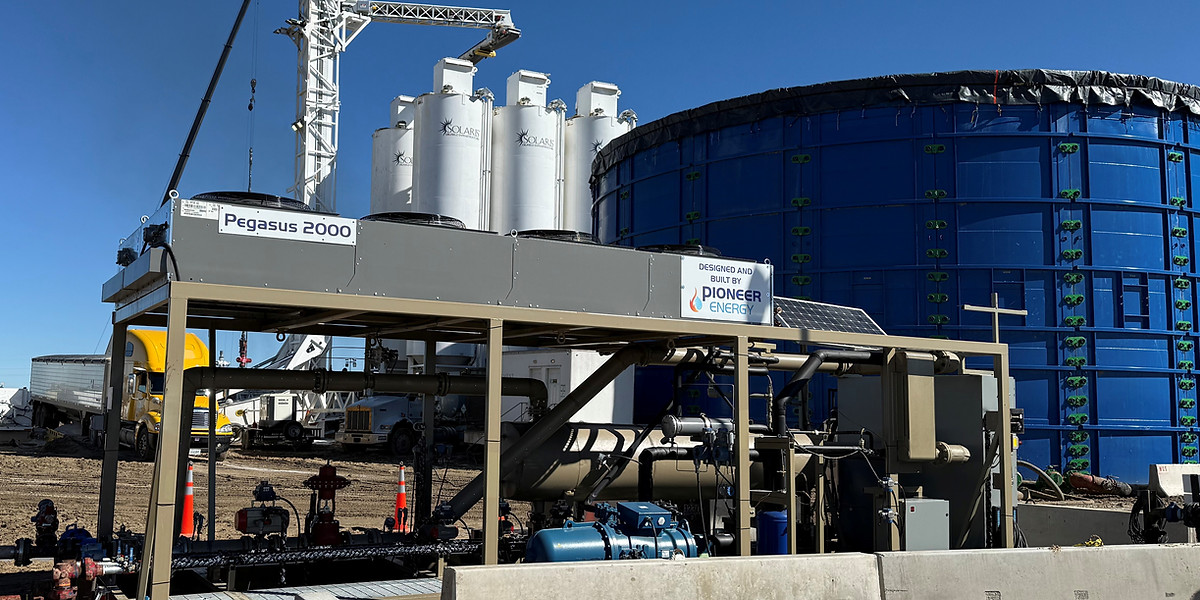
Pioneer Energy’s approach uses mechanical refrigeration in the Pegasus LP system to cool the gas stream to the temperature required to condense propane, butane, and heavier components while allowing methane and ethane to remain in the vapor phase.
The process flow:
1. Inlet treatment, Free liquids and solids are removed from the gas stream before refrigeration to protect the heat exchangers and compressors.
2. Compression (if required), Low-pressure gas streams are compressed to the inlet pressure required by the conditioning system.
3. Refrigeration and condensation, The gas stream is cooled using mechanical refrigeration. As temperature drops, the heavier hydrocarbon components (C3+) condense from the vapor phase into a liquid phase.
4. Liquid recovery, The condensed liquid, the Y-grade NGL, is collected and stored for truck-out.
5. Residue gas delivery, The leaner residue gas exits the system with a significantly elevated Methane Number, suitable for use as fuel gas for generators, compressors, or frac equipment.
The two products, Y-grade NGLs sold at liquids pricing and residue gas used as fuel or sold at gas pricing, together define the economics of the project.
The Economics of Field NGL Recovery
The value proposition is straightforward: NGLs are worth more per BTU than natural gas.
Propane typically trades at 2–4 times the BTU-equivalent price of natural gas. Butane and natural gasoline trade at similar or higher premiums. By recovering these components as liquids rather than selling them as gas, producers capture a significant portion of this value gap.
Example scenario:
A facility producing 1 MMscfd of associated gas with an NGL yield of 10 gallons per Mscf generates:
- 10,000 gallons per day of Y-grade NGLs
- At a blended Y-grade price of $0.80/gallon: $8,000 per day
- Annual liquids revenue: ~$2.9 million
Without NGL recovery, this same gas stream sold at $3.00/Mscf as natural gas generates:
- $3,000 per day
- Annual revenue: ~$1.1 million
The incremental value from NGL recovery, nearly $1.8 million annually in this example, is the economic driver behind field NGL projects.
Actual economics vary with gas composition, NGL yields, market pricing, and operating costs, but the directional case for NGL recovery from rich associated gas is consistently strong.
NGL Recovery from Tank Vapors
Tank vapor streams are often particularly attractive for NGL recovery because crude oil storage tank vapors tend to be rich in heavier components.
When crude oil enters a storage tank and dissolved gases flash out of solution, the resulting vapor stream contains significant quantities of propane, butane, and natural gasoline. These are exactly the components with the highest NGL value.
Pioneer Energy’s Pegasus LP, combined with vapor compression from tank batteries, can process this vapor stream and recover the heavy fraction as Y-grade NGLs, often achieving NGL yields of 15–30 gallons per Mscf or higher on rich tank vapor streams.
Modular NGL Recovery Without a Gas Processing Plant
The traditional barrier to NGL recovery for smaller operators has been infrastructure: gas processing plants are large, capital-intensive, and require pipeline connections that may not be available.
Pioneer Energy’s modular approach removes this barrier:
- Pegasus conditioning systems are skid-mounted and truck-transportable
- No permanent plant construction is required
- Y-grade NGL product is trucked to fractionation facilities
- Systems can be deployed, operated, and relocated as production profiles change
- Capital cost is a fraction of permanent plant infrastructure
This makes NGL recovery economically viable at flow rates and in locations that would not support a traditional gas plant investment.
Gas Quality Improvement as a Co-Benefit
An often-overlooked benefit of field NGL recovery is the simultaneous improvement in gas quality.
When propane, butane, and heavier components are removed from the gas stream, the Methane Number of the residue gas increases substantially. A gas stream that was MN 40 before processing may be MN 65+ after heavy hydrocarbon removal.
This means that field NGL recovery and fuel gas conditioning for generators or frac equipment are often the same operation, the same system that recovers NGL value also conditions the residue gas for engine use.
Pioneer’s Pegasus LP is designed to exploit this relationship, producing both Y-grade NGL truck-out product and high-Methane-Number fuel gas as simultaneous outputs.
Conclusion
Natural gas liquids recovery in the field gives upstream operators access to the premium value embedded in their associated gas, without requiring gas processing plant infrastructure, pipeline connectivity, or large volumes.
Pioneer Energy’s Pegasus LP and related conditioning systems make field NGL recovery practical at wellsites, tank batteries, and central production facilities across a wide range of gas compositions and flow rates.
For operators with rich associated gas streams currently being sold at gas pricing or disposed of through flaring, a project evaluation with Pioneer Energy can quantify the incremental value available through field NGL recovery.
Frequently Asked Questions
What are natural gas liquids (NGLs)?
Natural gas liquids (NGLs) are hydrocarbon components that exist as gas in the reservoir but can be recovered as liquids at surface conditions through processing. The main NGL components are ethane, propane, butane, isobutane, and natural gasoline (pentanes+). NGLs are recovered from both associated gas in oil production and from wet natural gas streams.
What is Y-grade NGL?
Y-grade NGL (also called mixed NGL or raw mix) is an unfractionated mixture of natural gas liquids recovered from field gas conditioning or gas processing. Y-grade contains ethane, propane, butane, isobutane, and natural gasoline in varying proportions depending on the source gas composition. It is typically trucked to a fractionation facility where the individual products are separated and sold.
How is field NGL recovery different from a gas processing plant?
A gas processing plant is a large permanent facility that processes high volumes of gas and separates individual NGL products for pipeline transportation. Field NGL recovery uses compact modular equipment at or near the production site to extract NGL value from a gas stream without requiring pipeline infrastructure. Field recovery systems are faster to deploy, lower in capital cost, and can make NGL recovery economic at sites too small or remote for a dedicated pipeline.
What is the Methane Number and why does it affect NGL recovery?
Methane Number (MN) measures a gas’s resistance to engine knock. When heavy hydrocarbons (propane, butanes, pentanes) are removed during NGL recovery, the Methane Number of the remaining residue gas increases. This means that NGL recovery and fuel gas conditioning are often complementary processes, recovering the liquids improves the gas quality for engine use simultaneously.
What field gas conditioning equipment is used for NGL recovery?
Pioneer Energy’s Pegasus LP system uses mechanical refrigeration to cool the gas stream and condense heavy hydrocarbons, recovering them as Y-grade NGLs. The system processes up to 2 MMscfd of field gas and is designed for modular field deployment without requiring permanent plant infrastructure.
Is field NGL recovery economical for smaller operators?
Yes, with modern modular systems. Previously, NGL recovery required large-scale plant infrastructure and high gas volumes to be economic. Pioneer Energy’s modular Pegasus systems make NGL recovery practical at much smaller flow rates and can be deployed at remote wellsites without pipeline infrastructure, with Y-grade NGL trucked to market.