
Oil wells do not produce forever under their own pressure. Most wells eventually reach a point where natural reservoir pressure is insufficient to push fluid to the surface efficiently, and when that happens, operators must choose an artificial lift method to keep the well producing.
Gas lift is one of the most widely used artificial lift technologies in the world. From the Permian Basin to Abu Dhabi, offshore platforms to remote inland pads, gas lift systems are found wherever operators need a reliable, flexible way to maintain or enhance production from wells that can no longer flow naturally.
Understanding how gas lift works, when it is used, and, critically, why the reliability of the surface gas lift compressor is so important to production uptime, is essential for any production engineer or operator managing a gas lift operation.
What Is Gas Lift in Oil and Gas Production?
Gas lift is an artificial lift method that enhances oil production by injecting high-pressure gas into the production tubing at depth, reducing the hydrostatic pressure of the fluid column and allowing reservoir pressure to drive more oil to surface.
The fundamental physics: the weight of a column of fluid in the production tubing creates backpressure that resists production. By injecting gas into the fluid column at depth, the fluid becomes lighter, a mixture of oil and gas with lower density than pure liquid, reducing the backpressure and allowing the reservoir to produce at higher rates than it could naturally.
It is, in essence, an engineered version of the natural gas drive that allows a young, high-pressure well to produce without assistance, but applied artificially at a controlled rate and depth throughout the life of a well.
How Does a Gas Lift System Work?
A complete gas lift system consists of surface equipment and downhole components working together to inject gas at the correct rate, pressure, and depth.
Surface Equipment
Gas lift compressor, The heart of the system. A gas lift compressor takes produced gas at relatively low pressure and compresses it to the injection pressure required by the well, typically 1,000 to 2,500 PSI or higher depending on well depth and design.
Gas supply and conditioning, The gas being compressed must be clean, dry, and properly conditioned. Raw associated gas often contains heavy hydrocarbons, free liquids, and contaminants that damage compressor engines and plug downhole equipment.
Control and instrumentation, Flow controls, pressure regulators, and monitoring instrumentation manage injection rate per well and ensure safe operation.
Downhole Equipment
Gas lift mandrels, Side-pocket mandrels installed in the production tubing string at specific depths hold the gas lift valves and create the connection between the injection gas and the production tubing.
Gas lift valves, Pressure-sensitive check valves that open when injection gas pressure is sufficient to enter the tubing and close to prevent backflow. A well typically has multiple valves at different depths, with the deepest operative valve being the primary injection point.
Production tubing and casing, The injection gas travels down the casing-tubing annulus and enters the production tubing through the gas lift valves at the design injection point.
Types of Gas Lift
Continuous Gas Lift
In continuous gas lift, gas is injected at a steady rate 24 hours a day. This is the most common gas lift configuration and is best suited for:
- Wells with sufficient liquid production rate to justify continuous injection
- Wells with stable reservoir pressure and productivity
- Facilities where consistent production rate is important
Continuous gas lift provides predictable, stable production and is well-suited to surface facilities designed for steady throughput.
Intermittent Gas Lift
Intermittent gas lift injects gas in controlled periodic slugs, each slug lifting a batch of accumulated liquid to surface. Between injections, the well builds up fluid in the tubing. This is used for:
- Low-rate wells where continuous injection is inefficient
- Wells with low reservoir pressure that needs time to recover between lift cycles
- Wells in the late stage of their production life
Intermittent gas lift is more mechanically complex to optimize but can maintain economic production from wells that would not respond well to continuous injection.
Plunger-Assisted Gas Lift
A variation that uses a mechanical plunger to improve liquid lifting efficiency in intermittent systems. The plunger acts as a piston in the tubing, providing a seal between the injected gas and the liquid above it.
When Is Gas Lift Used?
Gas lift is preferred when:
- Reservoir pressure has declined enough to reduce natural flow below economic rates
- Wells produce sand or scale that would damage other lift mechanisms
- High liquid rates are expected, gas lift handles high-volume liquid wells well
- Multiple wells share a compressor, gas lift is scalable across a pad or field from a central compression facility
- Offshore environments where simplicity and reliability of downhole equipment is critical
- Deviated or horizontal wells where rod pump deployment is challenging
Gas lift competes with rod pump (pumpjack), ESP, plunger lift, and hydraulic pump as artificial lift options. Each has advantages in specific conditions; gas lift tends to excel in offshore, high-liquid-rate, and multi-well centralized operation scenarios.
Why Gas Lift Compressor Uptime Is Critical
Gas lift is fundamentally dependent on the surface compressor. When the compressor runs, the well produces. When the compressor stops, the well stops.
This creates a very direct relationship between compressor reliability and production rate that does not exist in the same way with, for example, a rod pump. A rod pump failure affects one well. A gas lift compressor failure affects every well tied to that compressor, potentially dozens of wells in a centralized facility.
The production cost of a gas lift compressor shutdown is therefore multiplied by the number of wells on the system.
A 10-well gas lift system averaging 200 barrels per day per well at $70/bbl represents $140,000 per day of production. An unexpected 8-hour compressor shutdown costs $47,000 in deferred production, plus restart time, fluid fallback, and the labor to investigate and repair the problem.
This is why gas lift compressor fuel reliability receives so much attention from production engineers.
Why Raw Field Gas Causes Gas Lift Compressor Problems
Gas lift compressor engines, typically large natural gas reciprocating engines, require high-quality, consistent fuel gas to operate at their design conditions.
Raw associated gas from oil production presents several problems when used directly as compressor engine fuel.
Low Methane Number Causes Engine Knock
The heavy hydrocarbon components in associated gas (propane, butane, pentanes) depress the gas’s Methane Number below what the engine can safely combust without knock. Engine knock causes:
- Increased vibration and mechanical stress on pistons, rods, and bearings
- Elevated cylinder temperatures
- Reduced power output and efficiency
- Accelerated wear on critical engine components
- Shortened engine overhaul intervals and increased maintenance costs
Free Liquids Cause Hydraulic Hammer
Entrained condensate or water in the fuel gas stream enters the engine cylinders as liquid droplets. These incompressible liquid slugs cause hydraulic hammer, sudden mechanical shock loads that can crack cylinder heads and destroy engine components with a single event.
Composition Variability Causes Misfire and Shutdown
As field conditions change, gas composition fluctuates. When fuel quality changes faster than the engine’s control system can compensate, the engine misfires, trips on protective functions, or derate automatically. Each unplanned shutdown is a production event.
High Inlet Pressure Creates Additional Challenges
Gas lift compressors often take suction from high-pressure gas sources, compressor discharge, high-pressure gathering taps, at pressures of 800–1,200 PSI or higher. At these pressures, heavy hydrocarbons that would be gaseous at low pressure may be partially in liquid phase, creating conditioning challenges that require specifically designed equipment.
How Field Gas Conditioning Solves Gas Lift Fuel Problems
A field gas conditioning system positioned upstream of the gas lift compressor engine resolves all of these issues before the fuel reaches the engine.
Conditioning removes heavy hydrocarbons that depress Methane Number, eliminating the root cause of engine knock. Liquid separation and coalescing filtration removes free water and condensate, protecting against hydraulic hammer. Automated controls maintain consistent output quality across inlet condition changes, providing the stable fuel the engine needs for reliable operation.
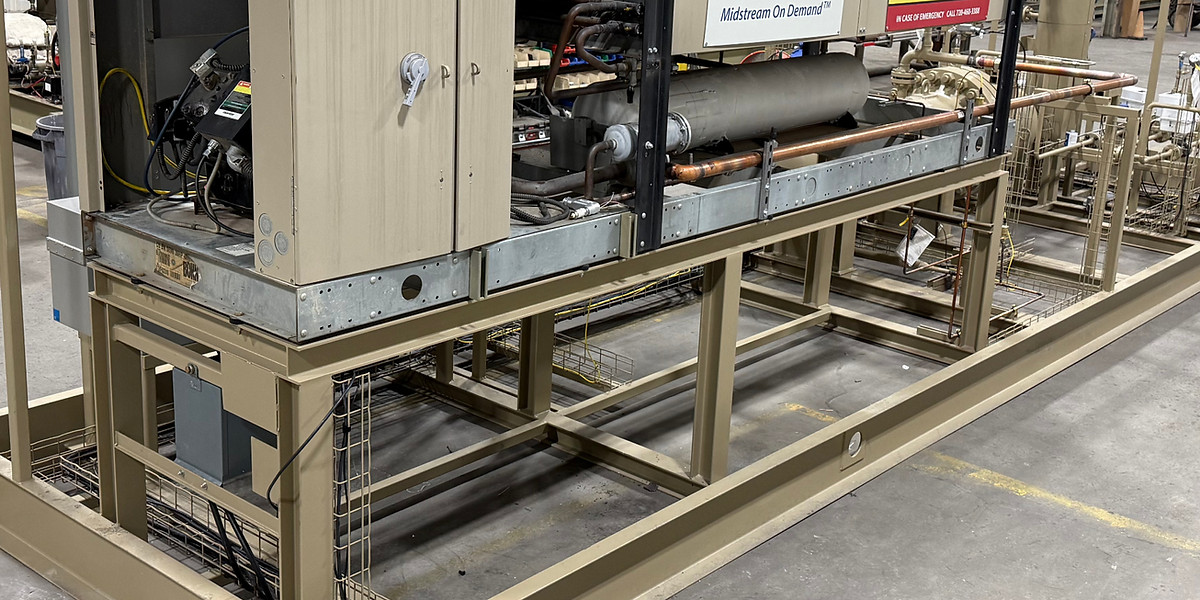
Pioneer Energy’s Pegasus Mini HP: Built for High-Pressure Gas Lift Applications
Pioneer Energy designed the Pegasus Mini HP specifically for high-pressure conditioning applications, including gas lift compressor fuel supply.
Key specifications:
- Up to 330 Mscfd capacity
- 800 to 1,200 PSI inlet pressure, no upstream compression required at high-pressure tap points
- MN 65+ output, above the minimum Methane Number for most reciprocating gas engines
- Skid-mounted, deployable at any production site without permanent plant construction
By accepting high-pressure inlet gas directly from compressor discharge or high-pressure gathering headers, the Pegasus Mini HP eliminates the need for additional inlet compression that would otherwise add cost and complexity.
For facilities with lower inlet pressures or higher gas volumes, Pioneer’s Pegasus LP and Pegasus VC offer alternative configurations for gas lift fuel supply, each tailored to different inlet conditions.
Pioneer also offers Gas Filtering, Heating, and Manifold Skids as auxiliary systems that complement the Pegasus conditioning systems, adding coalescing filtration, gas heating to prevent hydrate formation, and manifolding for multi-well injection distribution at higher capacities.
Measuring the Value of Better Gas Lift Compressor Uptime
The case for investing in fuel gas conditioning for a gas lift system is straightforward to quantify.
If a compressor currently operates at 92% uptime due to fuel-related shutdowns, improving to 98% uptime through fuel gas conditioning represents 6 percentage points of improvement, roughly 22 additional days of full production per year.
At a 10-well system averaging 200 bbl/day per well at $70/bbl, 22 additional production days are worth approximately $3.1 million per year in recovered production value.
A fuel gas conditioning system from Pioneer Energy is a fraction of that annualized value.
Conclusion
Gas lift is one of the most effective and widely used methods for maintaining oil production from wells that can no longer flow naturally. Its effectiveness depends entirely on the reliability of the surface gas lift compressor, and the compressor’s reliability depends heavily on the quality of its fuel gas.
Raw associated gas used directly as compressor engine fuel creates the exact conditions, low Methane Number, free liquids, variable composition, that drive compressor downtime and increase maintenance costs. Field gas conditioning eliminates these issues at the source.
Pioneer Energy’s Pegasus Mini HP and related conditioning systems are purpose-built for this application, protecting compressor engines, improving uptime, and safeguarding the production value that gas lift is designed to recover.
Contact Pioneer Energy to evaluate fuel conditioning options for your gas lift compressor operations.
Frequently Asked Questions
What is gas lift in oil and gas production?
Gas lift is an artificial lift method that injects compressed gas into the production tubing of an oil well at depth. The injected gas reduces the density of the fluid column above it, allowing reservoir pressure to push the oil to the surface more efficiently. It is one of the most widely used artificial lift methods globally.
How does a gas lift system work?
A gas lift system compresses high-pressure gas at the surface, then injects it downhole through gas lift valves in the production tubing or casing-tubing annulus. The gas mixes with produced fluids, creating a lighter, foamy mixture that flows to surface under reservoir pressure. Surface compressors, pipelines, and downhole valves are the key mechanical components.
What are the different types of gas lift?
The two primary types are continuous gas lift, where gas is injected continuously to maintain steady production, and intermittent gas lift, where gas is injected in periodic slugs to produce accumulated liquid from lower-rate wells. Continuous gas lift is more common in higher-rate wells; intermittent lift is used when production is low or reservoir pressure is limited.
What gas is used for gas lift injection?
Gas lift systems most commonly use the field’s own produced gas, associated gas that has been conditioned and compressed to the required injection pressure. The gas lift injection gas must be dry and free of heavy hydrocarbons and liquids to prevent valve plugging, freeze-ups, and hydrate formation downhole.
Why does gas lift compressor uptime matter so much?
Gas lift is used specifically because natural reservoir pressure is insufficient to produce oil without assistance. When the gas lift compressor shuts down, injection stops, the well stops flowing, and oil production halts. Even one or two hours of daily downtime on a gas lift system can cost thousands of dollars in deferred production.
How does fuel gas conditioning improve gas lift compressor reliability?
Gas lift compressor engines require clean, consistent, properly rated fuel gas. Raw field gas with a low Methane Number causes engine knock. Free liquids cause hydraulic hammer events. Variable composition leads to power output fluctuations. Field gas conditioning resolves all of these issues before the gas reaches the compressor engine, dramatically improving uptime.
What is the Pegasus Mini HP and how does it help gas lift operations?
The Pegasus Mini HP is a Pioneer Energy high-pressure field gas conditioning system designed for applications where inlet gas is available at 800–1,200 PSI, as is common at compressor discharge or high-pressure gathering connections. It conditions up to 330 Mscfd to MN 65+ without requiring inlet compression, making it well-suited for gas lift compressor fuel supply.