
Raw associated gas from oil production is not the same as the pipeline-quality natural gas that arrives at a city’s gas distribution system. It is a mixture of methane, heavier hydrocarbons, liquids, water vapor, hydrogen sulfide, and other components, inconsistent in composition, variable in pressure, and often damaging to the equipment it is supposed to power.
That is the problem field gas conditioning solves.
By treating raw field gas at the production site, operators can transform an unreliable and potentially damaging gas stream into consistent, clean fuel gas suitable for powering generators, compressors, frac equipment, and other critical field operations. In the process, they reduce diesel consumption, cut logistics costs, improve uptime, and lower emissions.
For upstream oil and gas operators, field gas conditioning is increasingly one of the most cost-effective investments on a producing property.
What Is Field Gas Conditioning?
Field gas conditioning is the process of treating raw associated gas or field gas at or near the production site to remove contaminants, liquids, and composition variability so that the gas can be reliably used as fuel gas, power generation feedstock, or another on-site energy application.
The goal is to produce a gas stream that:
- Has a consistent Methane Number suitable for gas engines
- Is free of free liquids that damage equipment
- Is within the pressure and temperature range required for downstream use
- Meets the combustion quality requirements of generators, compressors, or other consuming equipment
Field gas conditioning is distinct from full gas processing. It is designed for on-site treatment of smaller volumes with modular equipment, not for pipeline injection or NGL product separation at scale.
Why Does Raw Field Gas Require Conditioning?
Raw associated gas produced alongside crude oil presents several problems if used directly as fuel without treatment.
Heavy Hydrocarbon Content
Associated gas typically contains significant quantities of propane, butanes, and pentanes. These heavier components lower the gas’s Methane Number (MN), the measure of resistance to engine knock, analogous to octane rating for gasoline.
Using gas with a low Methane Number in high-compression gas engines causes knocking, detonation, accelerated wear, and engine failure.
Free Liquids
Raw gas often carries entrained condensate and produced water. Liquids entering a gas engine or turbine cause serious damage, including hydraulic hammer events that can destroy cylinders and pistons.
Variable Composition
The composition of associated gas changes constantly as reservoir conditions evolve, wells are added or shut in, and production rates fluctuate. Equipment designed to run on a consistent fuel cannot maintain peak performance on a gas stream that changes daily.
Hydrogen Sulfide and CO₂
Many associated gas streams contain H₂S and carbon dioxide. These components cause corrosion, reduce heating value, and create safety hazards.
Field gas conditioning addresses all of these issues before the gas reaches consuming equipment.
What Is Methane Number and Why Does It Matter?
Methane Number (MN) is one of the most important parameters in field gas conditioning.
- Pure methane has a Methane Number of 100, it is highly knock-resistant.
- As heavier hydrocarbons (ethane, propane, butane) are added, the Methane Number drops.
- Gas engines require fuel to meet a minimum Methane Number to operate without damage.
A gas engine rated for MN 70+ will experience knock, reduced power output, increased maintenance, and potential catastrophic failure if operated on gas with MN 50.
Field gas conditioning removes the heavy hydrocarbons that depress the Methane Number, lifting the gas to the level required for reliable engine operation.
Pioneer Energy’s Pegasus systems are designed to deliver conditioned gas at specific Methane Number targets:
- Pegasus Dream: MN 70+, up to 4 MMscfd
- Pegasus LP: MN 55+, up to 2 MMscfd
- Pegasus Mini HP: MN 65+, up to 330 Mscfd at high-pressure inlet (800–1,200 PSI)
- Pegasus VC: MN 55+, tank vapor capture and conditioning
How Does a Field Gas Conditioning System Work?
A field gas conditioning system typically processes the raw gas stream through several stages.
Inlet Separation
Free liquids, condensate and produced water, are removed in an inlet separator before the gas enters the conditioning system. This prevents liquid slugs from reaching downstream equipment.
Filtration and Coalescing
Fine liquid mist and solid particulates are removed through coalescing filters and separators. This produces a dry, clean gas stream for further treatment.
Heavy Hydrocarbon Removal
This is the core conditioning step. Heavy hydrocarbon components are removed using refrigeration, absorption, or other separation technologies. The choice of method depends on gas composition, flow rate, and the target Methane Number output.
The removed heavy hydrocarbons represent the heavier components of the gas, propane, butanes, and pentanes. These can be recovered separately as liquids or blended back in controlled quantities to optimize gas quality.
Pressure Regulation and Delivery
The conditioned gas is regulated to the delivery pressure required by downstream consuming equipment and delivered as a consistent, on-spec fuel gas stream.
Field Gas Conditioning Applications
Conditioned field gas can be used across a broad range of oilfield energy applications.
Power Generation
Gas generators at remote production facilities can run on conditioned field gas, replacing or supplementing diesel. This reduces fuel costs, lowers logistics complexity, and cuts carbon intensity.
Frac Fleet Operations
Dual-fuel and dedicated gas frac equipment can use conditioned field gas to displace diesel during hydraulic fracturing operations. This is one of the fastest-growing applications for field gas conditioning.
Gas Lift Compression
Gas lift systems used to boost production from declining wells require a clean, consistent gas supply. Field gas conditioning ensures the lift gas stream meets the purity requirements for compressors and downhole equipment.
Artificial Lift and ESP Power
Electrification at remote production sites increasingly uses field gas as the power source. Conditioned gas powers the generators that run electric submersible pumps and other artificial lift systems.
Data Centers and AI Infrastructure
A newer and rapidly growing application involves powering remote data centers and AI computing infrastructure with conditioned field gas. Pioneer Energy’s systems are increasingly being evaluated for this application, where reliable, high-quality gas supply is critical.
The Economics of Field Gas Conditioning
The business case for field gas conditioning centers on three value drivers:
Diesel displacement, Replacing diesel with on-site conditioned gas can save operators $2–$5 per gallon equivalent, with significant cumulative savings on high-fuel-consumption operations like frac fleets or continuous power generation.
Equipment protection, Unconditioned gas causes engine knock, liquid damage, and accelerated wear. A single engine failure or major maintenance event often costs more than the conditioning system itself.
Uptime, Reliable, consistent fuel gas improves equipment uptime and reduces unplanned shutdowns. In producing environments where every day of uptime has direct revenue impact, this matters significantly.
Modular Systems for Field Deployment
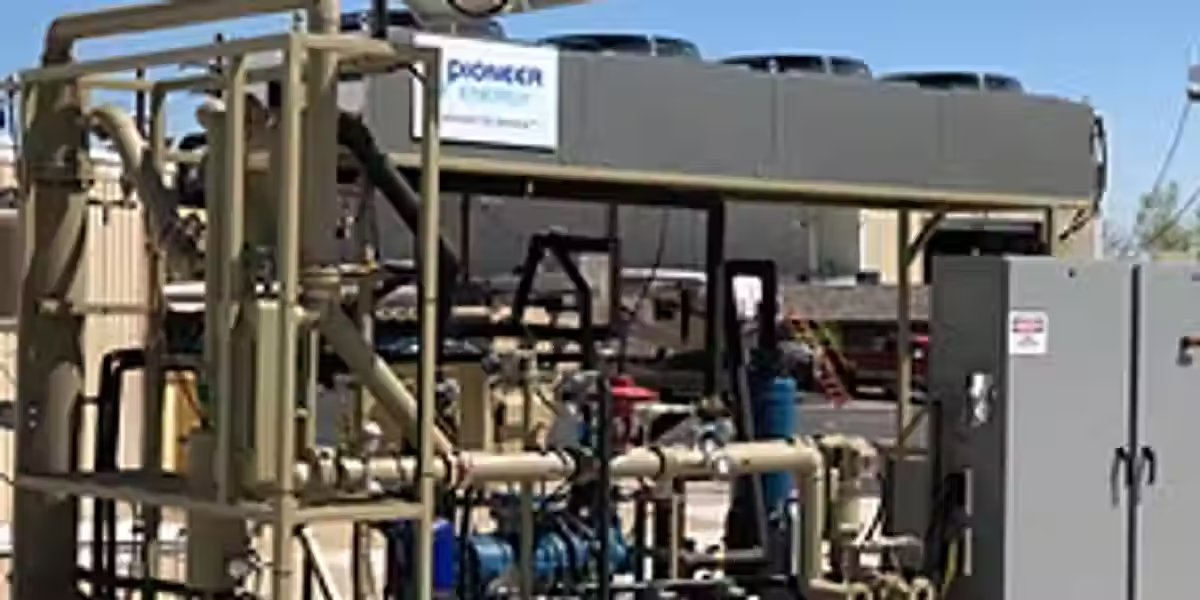
Traditional gas conditioning solutions were designed for large-scale plant facilities. Pioneer Energy’s approach is different: the entire Pegasus product family is engineered as modular skid-packaged systems that can be transported by truck and deployed at remote wellsites.
This means:
- Faster deployment, weeks rather than months
- Lower capital cost, no permanent facility construction required
- Flexibility, systems can be relocated as operations move
- Scalability, multiple units can be combined for higher flow rates
Pioneer builds these systems at the company’s Colorado manufacturing facility, including in-house fabrication of ASME code-stamped pressure vessels, UL 508-A rated electrical panels, and HMI development.
What to Look for in a Field Gas Conditioning System
When evaluating field gas conditioning solutions, operators should consider:
- Target Methane Number, does the system deliver the MN required by your engines?
- Inlet pressure range, does the system match your wellsite pressure conditions?
- Flow rate capacity, is the system sized for your gas volumes?
- Reliability in field conditions, freeze-up resistance, hydrate prevention, paraffin tolerance
- Remote monitoring, cloud-enabled controls with SCADA integration
- Service and support, on-site commissioning, training, and ongoing warranty support
Pioneer Energy offers a complimentary gas analysis using your gas composition data and proprietary HYSYS modeling to predict conditioned gas output and project economics before any capital commitment.
Conclusion
Field gas conditioning transforms raw associated gas from a potential liability into a valuable, reliable on-site energy source. By removing heavy hydrocarbons, liquids, and contaminants, conditioning systems protect equipment, improve uptime, reduce diesel dependence, and lower the cost of energy at remote production sites.
Pioneer Energy’s Pegasus family of modular field gas conditioning systems is designed specifically for this challenge, engineered for field deployment, built for reliability, and configured to match the specific conditions of each operator’s project.
Frequently Asked Questions
What is field gas conditioning?
Field gas conditioning is the process of treating raw associated gas or field gas at the production site to remove contaminants, liquids, and inconsistencies that prevent it from being used as fuel or transported downstream. Conditioning produces a reliable, on-spec gas stream suitable for power generation, compression, or other on-site energy applications.
Why does associated gas need to be conditioned?
Raw associated gas from oil production contains heavy hydrocarbons, free liquids, hydrogen sulfide, carbon dioxide, and other contaminants. This untreated gas damages engines, compressors, and turbines, and produces inconsistent combustion. Conditioning removes these components to produce a clean, consistent fuel gas stream.
What is the difference between field gas conditioning and gas processing?
Gas processing typically refers to large-scale plant operations designed to extract NGL products and pipeline-quality gas for sale. Field gas conditioning is performed at or near the production site using compact, modular equipment designed to treat smaller volumes for on-site use. Field conditioning is faster to deploy, lower in capital cost, and does not require pipeline infrastructure.
What is a Methane Number in field gas conditioning?
Methane Number (MN) is a rating that measures how resistant a gas is to engine knock, similar to octane rating in gasoline. Raw associated gas often has a low Methane Number due to heavy hydrocarbon content. Field gas conditioning removes these heavy components, raising the Methane Number and making the gas safe for use in high-compression gas engines.
What equipment is used for field gas conditioning?
Field gas conditioning systems typically include inlet separators, coalescing filters, heat exchangers, refrigeration or absorption units to remove heavy hydrocarbons, pressure regulators, and instrumentation. Pioneer Energy’s Pegasus product family offers modular skid-mounted systems covering a wide range of flow rates and inlet pressures.
Can field gas conditioning replace diesel fuel?
Yes. Field gas conditioning produces an on-spec fuel gas stream that can power natural gas generators and dual-fuel or dedicated gas engines. Many operators use conditioned field gas to partially or completely replace diesel at remote sites, reducing fuel costs and logistics complexity.