
Every crude oil storage tank at every tank battery in every producing basin is, at this moment, generating hydrocarbon vapors.
Some of those vapors escape through pressure relief valves or tank thief hatches. Some are combusted in a flare stack. Some are piped to a vapor recovery unit. And in many operations, some proportion simply vents to atmosphere, an invisible stream of methane and volatile organic compounds that costs operators product value while creating regulatory liability.
Tank vapor capture is the practice of intercepting those vapors before they escape or are destroyed, and converting them into something useful: fuel gas for on-site generators and compressors, or higher-value products like Y-grade Natural Gas Liquids (NGLs).
The economics are compelling. The regulatory pressure is increasing. And the technology to do it cost-effectively at field scale now exists.
Why Do Storage Tanks Produce Vapors?
Crude oil is not a simple liquid. It is a complex mixture of hydrocarbons ranging from very heavy components, asphaltenes, resins, down to light components including methane, ethane, propane, and butanes, which are dissolved in the liquid under reservoir pressure.
As crude oil moves from the wellbore through surface equipment and into atmospheric storage tanks, pressure drops dramatically. When pressure drops below the bubble point of these dissolved gases, they flash out of solution, transitioning from dissolved liquid-phase components into vapor-phase gases.
This process generates what the industry calls flash gas or tank vapors.
The volume and composition of tank vapors depends on:
- Crude oil composition and API gravity
- Wellbore pressure and separator operating pressure
- Number of separation stages
- Storage tank temperature
- Flow rate through the tank battery
High-GOR (Gas-Oil Ratio) crude, light oil, and crude with high concentrations of pentanes and lighter components will generate significantly more tank vapor than heavier, lower-GOR crude.
What Are the Sources of Storage Tank Emissions?
Storage tank emissions come from three primary mechanisms.
Flash emissions are generated when produced crude enters a storage tank from a high-pressure separator. The pressure reduction causes dissolved gases to flash out of solution rapidly. Flash emissions are the largest source of tank vapor for most production facilities.
Working losses occur as the liquid level in a tank rises and falls during normal operations. As liquid enters, vapors are displaced from the tank vapor space and released. As liquid leaves, outside air is drawn in and saturated with hydrocarbon vapors before being released.
Breathing losses result from the daily heating and cooling cycle. As tank temperature rises during the day, vapor pressure increases and vapors are released. As temperature drops at night, vapors condense back to liquid, but the net daily cycle often results in a net emission.
The Value in Tank Vapors
Tank vapors are not simply methane. In most producing formations, tank vapors contain substantial quantities of heavier hydrocarbons, propane, butanes, and natural gasoline, that have significantly higher market value than natural gas.
When operators vent or flare tank vapors, they are destroying not just methane but also:
- Propane (approximately $0.70–$1.00/gallon market value)
- Butanes (approximately $0.80–$1.20/gallon market value)
- Natural gasoline / pentanes (approximately $1.00–$1.50/gallon market value)
On a tank battery generating 100 Mscfd of vapor with 5–10 gallons per Mscf of NGL content, the daily liquids value alone can exceed several thousand dollars, an annualized opportunity that easily justifies vapor capture infrastructure.
What Is a Tank Vapor Capture System?
A tank vapor capture system collects vapors from the tank battery vapor space, treats them to remove liquids and contaminants, and routes the conditioned gas stream to a productive end use.
A complete system typically includes:
Vapor collection headers, low-pressure piping connecting each storage tank’s vapor outlet to the collection system.
Suction scrubbers, remove any entrained liquid before the gas reaches the compressor, protecting equipment from liquid slugs.
Compression, raises the vapor stream from near-atmospheric pressure to a level suitable for downstream use or processing.
Conditioning equipment, removes heavy hydrocarbons, free water, and other contaminants. This step is essential for converting tank vapors into usable fuel gas and for recovering NGL value.
Delivery to end use, conditioned gas is delivered as fuel to generators, compressors, or other equipment, or routed to a gas gathering system.
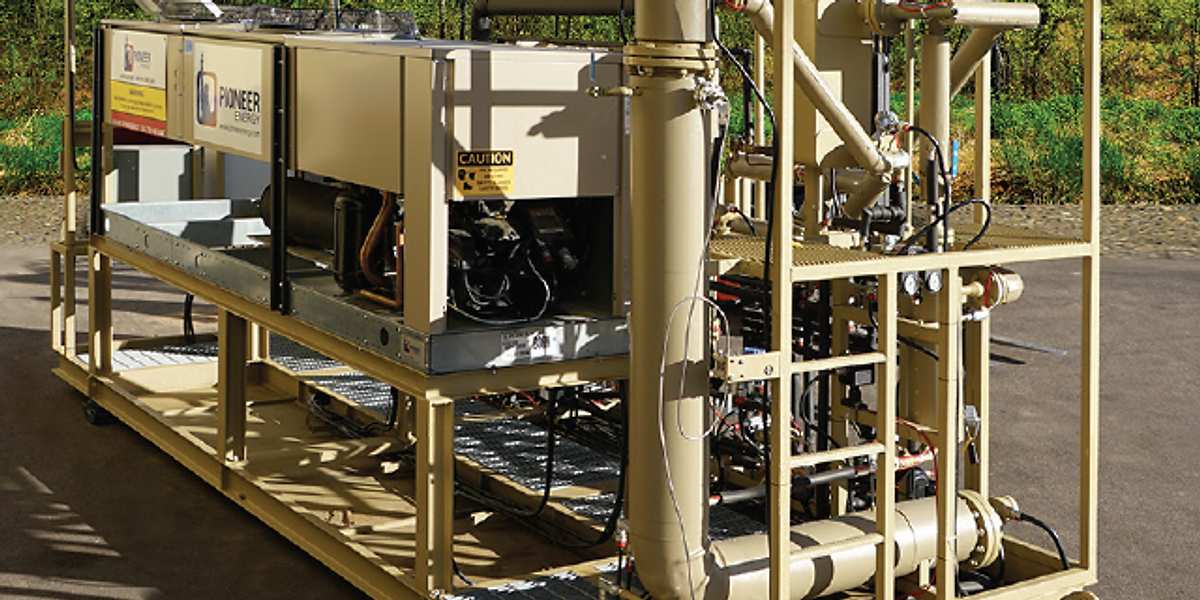
Pioneer Energy’s Pegasus VC: Purpose-Built for Tank Vapor Capture
Pioneer Energy’s Pegasus VC system is specifically designed for tank vapor capture and field gas conditioning. It handles up to 450 Mscfd with an inlet pressure range of 150 to 220 PSI and delivers conditioned gas at Methane Number 55+.
Unlike a basic vapor recovery compressor that simply compresses vapors and routes them to a gathering system, the Pegasus VC conditions the captured vapor stream, removing liquids, stabilizing composition, and delivering an on-spec fuel gas output that can power generators and other equipment directly.
For higher-volume facilities or those with richer vapor compositions where NGL recovery is the primary objective, Pioneer’s Pegasus LP can be deployed after initial vapor compression to process the recovered stream through mechanical refrigeration and recover the heavy components as truckable Y-grade NGLs.
From Vapors to Y-Grade NGLs
The NGL recovery pathway transforms tank vapor capture from an emissions control project into a hydrocarbon monetization project.
The process flow follows this sequence:
- Storage tanks generate vapors containing methane, ethane, propane, butanes, and pentanes
- The Pegasus VC captures and initially conditions the vapor stream
- The Pegasus LP processes the conditioned stream using mechanical refrigeration
- Heavy hydrocarbons are recovered as Y-grade NGLs, propane, butane, and natural gasoline, trucked to market at liquids pricing
- The lean residue gas is delivered as fuel or pipeline gas
This approach can recover significantly more value per Mscf than selling the raw vapor into a gas gathering system at natural gas pricing.
Regulatory Drivers for Tank Vapor Capture
The regulatory environment for storage tank emissions has tightened substantially across all major U.S. producing states.
EPA’s New Source Performance Standards (NSPS) require vapor controls on storage tanks above production thresholds in high-ozone regions.
State rules in Colorado, New Mexico, and California impose some of the most stringent tank emission requirements in the country. Colorado’s COGCC rules require comprehensive vapor controls at many production facilities regardless of federal thresholds.
Air quality permits at many facilities specify maximum allowable VOC and methane emissions from storage vessels. Tank vapor capture is the primary compliance tool.
Proactive vapor capture projects reduce regulatory risk and demonstrate good faith environmental stewardship, increasingly important for operators working to maintain social license in communities near production operations.
Evaluating a Tank Vapor Capture Project
The key inputs for a tank vapor capture project evaluation include:
- Tank vapor composition (rich vs. lean)
- Average and peak vapor generation rate (Mscfd)
- Current vapor disposition (venting, flaring, or partial capture)
- Available power at the facility
- Distance to gas gathering infrastructure
- NGL market access and trucking logistics
- Applicable regulatory requirements
Pioneer Energy offers a complimentary project evaluation using your facility’s vapor data to estimate conditioned gas output, NGL yield, fuel gas value, and overall project economics.
Conclusion
Storage tank vapors represent one of the most consistent and accessible revenue opportunities at upstream oil and gas facilities. The hydrocarbons in those vapors are real, they are valuable, and in most cases the technology to capture and monetize them is now both mature and cost-effective to deploy at field scale.
Pioneer Energy’s Pegasus VC and Pegasus LP systems are purpose-built for this application, turning tank battery vapors from a regulated emission source into a fuel gas supply or a source of truckable Y-grade NGLs.
For operators looking to reduce emissions, increase revenue from an existing production asset, or achieve regulatory compliance more cost-effectively, tank vapor capture deserves a close look.
Frequently Asked Questions
What is tank vapor capture?
Tank vapor capture is the process of collecting hydrocarbon vapors released from crude oil storage tanks and production equipment, then conditioning and utilizing those vapors as fuel gas or processing them into higher-value products such as Y-grade NGLs, instead of releasing them through venting or flaring.
Why do crude oil storage tanks emit vapors?
Crude oil contains dissolved light hydrocarbons that flash out of solution when pressure decreases as crude moves from the wellbore through separators into storage tanks. These flash gases accumulate in the vapor space above the stored liquid. Working losses occur as liquid level fluctuates, and breathing losses occur from daily temperature cycles.
What is flash gas in oil production?
Flash gas is the hydrocarbon vapor that comes out of solution when produced crude oil undergoes pressure reduction as it moves through separators and into atmospheric storage tanks. The lighter components, methane, ethane, propane, and butanes, vaporize and accumulate in the tank vapor space. Flash gas is the primary source of storage tank emissions.
What is a Pegasus VC?
The Pegasus VC is Pioneer Energy’s purpose-built tank vapor capture and field gas conditioning system. It collects vapors directly from crude oil storage tanks and tank batteries, conditions the gas stream to remove heavy hydrocarbons and liquids, and delivers clean on-spec fuel gas while recovering NGL value from the heavy fraction.
How does tank vapor capture reduce emissions?
Tank vapor capture prevents hydrocarbon vapors from being released to atmosphere through venting or consumed in a flare. By capturing and utilizing these vapors, operators eliminate direct methane and VOC emissions from tank batteries, significantly reducing their regulated emissions inventory and improving compliance with air quality rules.
Can tank vapors be converted to NGLs?
Yes. Tank vapors are often rich in propane, butanes, and pentanes. Field gas conditioning systems like Pioneer Energy’s Pegasus LP can process captured tank vapors to remove and recover these heavy components as truckable Y-grade NGLs, while the residual lean gas is used as fuel or injected into gathering systems.