
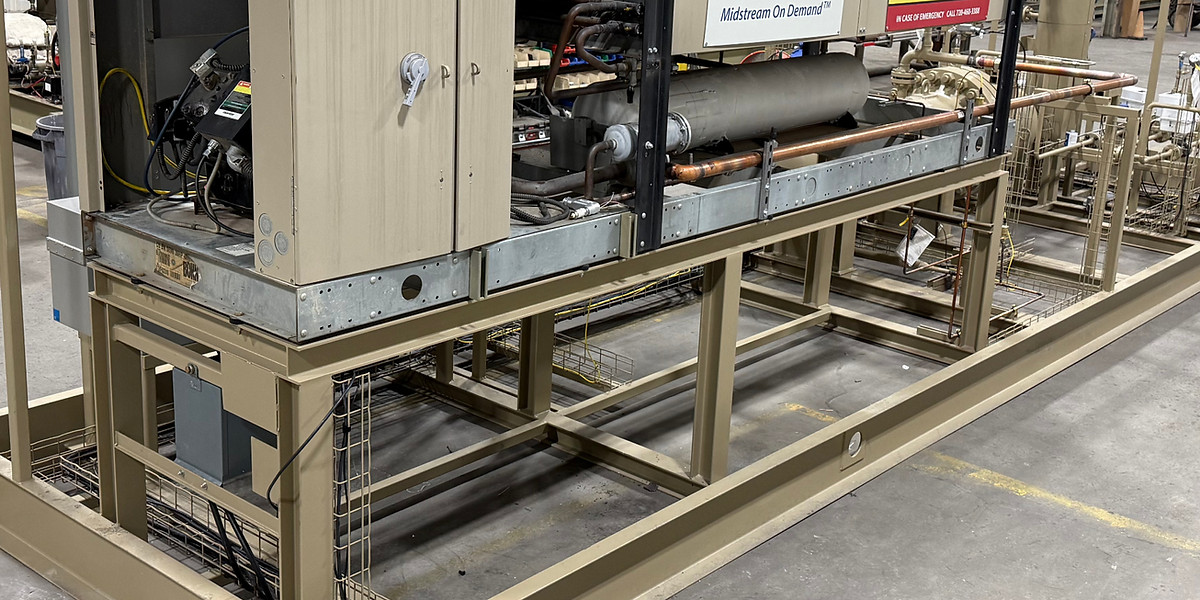
A gas lift compressor is the most mission-critical piece of surface equipment on a gas lift well or field. When it runs, the wells produce. When it stops, for any reason, every well connected to it stops producing until it restarts.
Given that direct relationship between compressor uptime and oil production, operators invest significantly in compressor redundancy, maintenance programs, and monitoring systems to maximize availability. Yet one of the most common causes of gas lift compressor downtime, poor fuel gas quality, often receives far less attention than the compressors themselves.
Raw associated gas used directly as compressor engine fuel is the root cause of three specific failure modes that destroy gas lift compressor uptime: misfires, engine knock, and fuel system freeze-ups. Each is preventable. Each has a consistent, well-understood technical solution.
Understanding the Gas Lift Compressor’s Fuel Requirement
A gas lift compressor engine is a spark-ignited natural gas engine operating under demanding conditions: continuous duty cycle, variable load as wells gas-lift demand fluctuates, and often remote location with limited maintenance access.
The engine’s fuel system requirements can be summarized in three parameters:
Methane Number (MN), The fuel must have a Methane Number at or above the engine manufacturer’s minimum specification (typically MN 65–80 for lean-burn engines, MN 55–70 for rich-burn and dual-fuel engines). Below minimum MN, knock occurs.
Liquid-free, The fuel gas must be free of entrained liquids. Any condensate or water entering the engine as liquid rather than vapor causes hydraulic events that can destroy the engine in a single slug event.
Consistent pressure and composition, The fuel supply must arrive at the fuel control valve within the engine’s acceptable inlet pressure range and without sudden compositional changes that the air-fuel ratio control system cannot track.
Raw associated gas from the production field reliably fails all three requirements.
Misfire: The First Symptom of Fuel Gas Problems
A misfire is an incomplete or absent combustion event in an engine cylinder during a firing cycle. The spark fires but the fuel-air mixture does not ignite, or ignites partially and incompletely.
Why Misfires Happen
The primary cause of misfires in a gas lift compressor context is fuel gas with a Methane Number approaching or below minimum specification. When MN is too low, the fuel-air mixture approaches or crosses the autoignition threshold at the prevailing compression ratio and temperature conditions. The combustion process becomes unstable, some cycles ignite normally, others partially, others not at all.
A secondary cause is sudden composition changes, a slug of unusually lean gas followed by a slug of unusually rich gas. The engine’s air-fuel ratio control system cannot instantaneously respond, producing a temporary out-of-spec fuel condition that generates misfires during the transition.
What Misfires Cost
Individual misfire events generate:
- Unburned fuel passing through to the exhaust, increasing emissions and carbon fouling of exhaust system components
- Power imbalance across cylinders, creating vibration that stresses bearings and connecting rods
- Elevated exhaust temperature in cylinders that do fire (compensating for misfired cylinders)
- Activation of engine protection systems that trip the compressor offline
More broadly, persistent misfires accelerate wear on ignition components (spark plugs, igniters, coils), require more frequent tune-up intervals, and erode operator confidence in the compressor’s reliability, leading to over-conservative maintenance decisions that cost both money and uptime.
Engine Knock: The Compressor Killer
If misfires are the early warning sign, engine knock is the consequential failure mode that destroys compressor engines.
The Physics of Knock in a Compressor Engine
When fuel gas has a Methane Number below the engine’s minimum specification, the compressed fuel-air mixture in some cylinders reaches autoignition conditions before the spark plug fires. A secondary combustion front propagates rapidly across the combustion chamber, colliding with the primary flame front in a characteristic pressure spike, the knock event.
The pressure spike from knock is not merely higher than normal combustion pressure, it is a shockwave that creates localized stress concentrations on combustion chamber surfaces far exceeding normal operating design loads.
The Damage Pattern
Knock damage in a gas lift compressor engine follows a predictable progression:
Early knock, Elevated cylinder temperature, increased vibration, slight power reduction. These symptoms are detectable with proper instrumentation but often missed in remote, unmonitored installations.
Sustained moderate knock, Piston crown erosion begins. Pitting develops on the crown surface. Ignition timing settings shift as the control system attempts to retard timing to reduce knock intensity. Engine output decreases.
Severe knock, Through-piston burn-through, cracked cylinder heads, spun bearings, and bent connecting rods. The engine fails catastrophically, typically requiring complete replacement of the affected cylinders or a full engine overhaul.
A single severe knock event at a remote gas lift station can cost $50,000–$200,000 in parts and labor, plus the lost production value during the repair and restart period.
The Methane Number Root Cause
The root cause is always the same: fuel gas with a Methane Number below minimum specification because it contains too much propane, butane, and heavier components from the associated gas stream.
The fix is equally consistent: condition the fuel gas to remove the heavy components before they reach the engine, raising the Methane Number to specification.
Freeze-Ups: The Silent Compressor Stopper
Freeze-ups in gas lift compressor fuel systems are among the most frustrating operational problems because they appear and disappear with temperature conditions, leading operators to attribute them to ambient temperature effects rather than the underlying fuel gas quality issue.
The Mechanism
Two distinct freeze-up mechanisms affect gas lift compressor fuel systems:
Free water freezing at pressure letdown, When high-pressure fuel gas flows through a pressure regulator or control valve, it experiences Joule-Thomson cooling, the gas temperature drops as pressure drops, sometimes by 20–50°F across the valve. If the gas contains free water, that water freezes at the valve seat or in the downstream piping, progressively blocking fuel flow.
Hydrate formation, Natural gas hydrates are ice-like crystalline structures that form when natural gas and water are present together at elevated pressure and temperatures well above 32°F. Methane hydrates can form at temperatures up to 65–70°F at typical compressor fuel system pressures. Hydrates plug fuel lines rapidly and are particularly insidious because they can block a fuel system at ambient temperatures that feel comfortable.
The High-Pressure Inlet Problem
Gas lift compressor fuel supply systems frequently take gas from high-pressure sources, compressor discharge, high-pressure gathering manifolds, at 800–1,200 PSI or higher. This high inlet pressure, combined with the large pressure drop to engine fuel supply pressure (5–30 PSI), creates extreme Joule-Thomson cooling across the pressure regulator.
Without upstream gas heating, the outlet temperature of that regulator can drop 40–80°F below inlet temperature, easily reaching temperatures that freeze water or form hydrates even in warm ambient conditions.
Prevention: Heat Before You Letdown
The proper solution is to heat the fuel gas upstream of the pressure letdown point, before the Joule-Thomson cooling occurs. A fuel gas conditioning system equipped with integrated gas heating raises the inlet gas temperature sufficiently that even after full pressure letdown, the gas temperature remains above hydrate formation and water freeze-up conditions.
Pioneer Energy’s fuel conditioning systems incorporate gas heating as an integrated design element, not an afterthought, sized specifically for the inlet pressure, letdown ratio, and ambient conditions at the compressor installation.
The Compounding Effect: All Three Failure Modes Together
In practice, raw associated gas used as compressor fuel does not cause just one of these problems, it causes all three simultaneously.
A Permian Basin gas lift compressor running on untreated associated gas at 800 PSI inlet pressure will simultaneously experience:
- Low MN fuel (MN 35–50) that causes knock and eventual piston damage
- Free liquid carry-over from the gathering system that causes misfire trips
- Hydrate formation at the pressure regulator that causes fuel starvation and shutdown
Each failure mode generates maintenance calls, repair events, and unplanned shutdowns. Together, they may reduce an otherwise 95%+ available compressor to 80–85% availability, with each lost percentage point costing thousands of dollars per day in deferred production.
Pioneer Energy’s Solution: High-Pressure Fuel Gas Conditioning
Pioneer Energy’s Pegasus Mini HP addresses all three failure modes with a single integrated system designed specifically for high-pressure gas lift compressor fuel supply applications.
MN correction, Refrigeration-based heavy hydrocarbon removal raises the conditioned gas Methane Number to MN 65+, eliminating the root cause of knock.
Liquid removal, Upstream separation and coalescing filtration removes free water and condensate before the gas reaches the engine fuel system, preventing hydraulic events and freeze-up precursors.
Integrated heating, Gas heating upstream of pressure letdown prevents Joule-Thomson cooling from creating freeze-up conditions at the fuel control valve.
The Pegasus Mini HP is optimized for 800–1,200 PSI inlet pressure, the typical operating range at compressor discharge or high-pressure gathering taps, handling up to 330 Mscfd without requiring separate inlet compression. For lower-pressure applications or higher volumes, the Pegasus LP and Pegasus VC offer complementary configurations.
Pioneer’s Gas Filtering, Heating, and Manifold Skids provide add-on capability for operators needing enhanced filtration or multi-unit fuel gas manifolding at larger compressor stations.
Quantifying the ROI
The return on investment for gas lift compressor fuel conditioning is straightforward to model:
Baseline: A gas lift compressor running 10 connected wells averaging 150 bbl/day each at $70/bbl = $105,000/day production value. At 85% availability due to fuel-related issues, effective production is $89,250/day.
With conditioning: Availability improves to 97%+. Effective production rises to $101,850/day, a $12,600/day improvement in realized production value, or approximately $4.6M annually.
In addition: reduced maintenance costs, extended engine overhaul intervals, and lower parts consumption over the compressor fleet’s life.
The capital cost of a Pegasus Mini HP fuel conditioning system recovers within weeks to months on a productive gas lift installation.
Conclusion
Gas lift compressor misfires, knock, and freeze-ups are not inevitable facts of oilfield operations. They are predictable failure modes with well-understood causes, all tracing back to raw associated gas used as compressor engine fuel without conditioning.
Pioneer Energy’s Pegasus Mini HP and related fuel conditioning systems eliminate all three failure modes at the source: raising Methane Number to engine specification, removing liquids before they reach the fuel system, and preventing freeze-ups through integrated gas heating.
Contact Pioneer Energy to evaluate fuel gas conditioning options for your gas lift compressor applications.
Frequently Asked Questions
What causes misfires in gas lift compressor engines?
Misfires are typically caused by low Methane Number fuel gas, free liquid slugs in the fuel line, or sudden changes in fuel gas composition. Low MN gas fails to ignite reliably at normal spark timing, producing misfired cylinders, vibration, and protective shutdowns.
What causes engine knock in gas lift compressor applications?
Engine knock occurs when fuel gas has a Methane Number below the engine’s minimum specification. Heavy hydrocarbons in raw associated gas (propane, butane, pentane) depress MN, causing premature auto-ignition before the spark fires. Sustained knock causes piston damage, cracked cylinder heads, and accelerated bearing wear.
What causes freeze-ups in gas lift compressor fuel systems?
Freeze-ups occur when water vapor condenses and freezes at pressure letdown points, or when natural gas hydrates form at temperatures well above 32°F. Both are triggered by large pressure drops through fuel regulators, where Joule-Thomson cooling drops gas temperature below hydrate formation or water freezing conditions.
How does a fuel gas conditioning system prevent freeze-ups?
A fuel conditioning system removes free water and water vapor, then heats the gas upstream of pressure letdown valves. Heating before pressure drop prevents Joule-Thomson cooling from reaching hydrate formation or freezing temperatures, eliminating the root cause of freeze-up events.
How quickly does poor fuel gas quality show up in compressor maintenance costs?
The impact is rapid. Engines on low-MN fuel show elevated vibration, cylinder temperature variances, and more frequent ignition failures within weeks. Compressor overhaul intervals can shorten from 24–30 months to 12–18 months or less, adding hundreds of thousands per year in maintenance costs across a multi-compressor station.