
In oil and gas production, infrastructure decisions made at the beginning of a field’s life determine operating costs and flexibility for decades. For gas processing, the conditioning, treating, and separation of produced gas streams, that infrastructure decision has historically defaulted to permanent, field-erected plants engineered for a specific set of conditions and bolted to the ground until decommissioning.
That default is changing.
Modular, skid-mounted gas processing systems have become the preferred approach for an expanding range of upstream and midstream applications. The shift is driven by demonstrable advantages in deployment speed, capital efficiency, operational flexibility, and risk management, advantages that permanent plant design fundamentally cannot match.
Understanding when and why modular systems outperform permanent plant alternatives requires examining the actual economics of each approach across the full project lifecycle.
What Makes a Gas Processing System “Modular”?
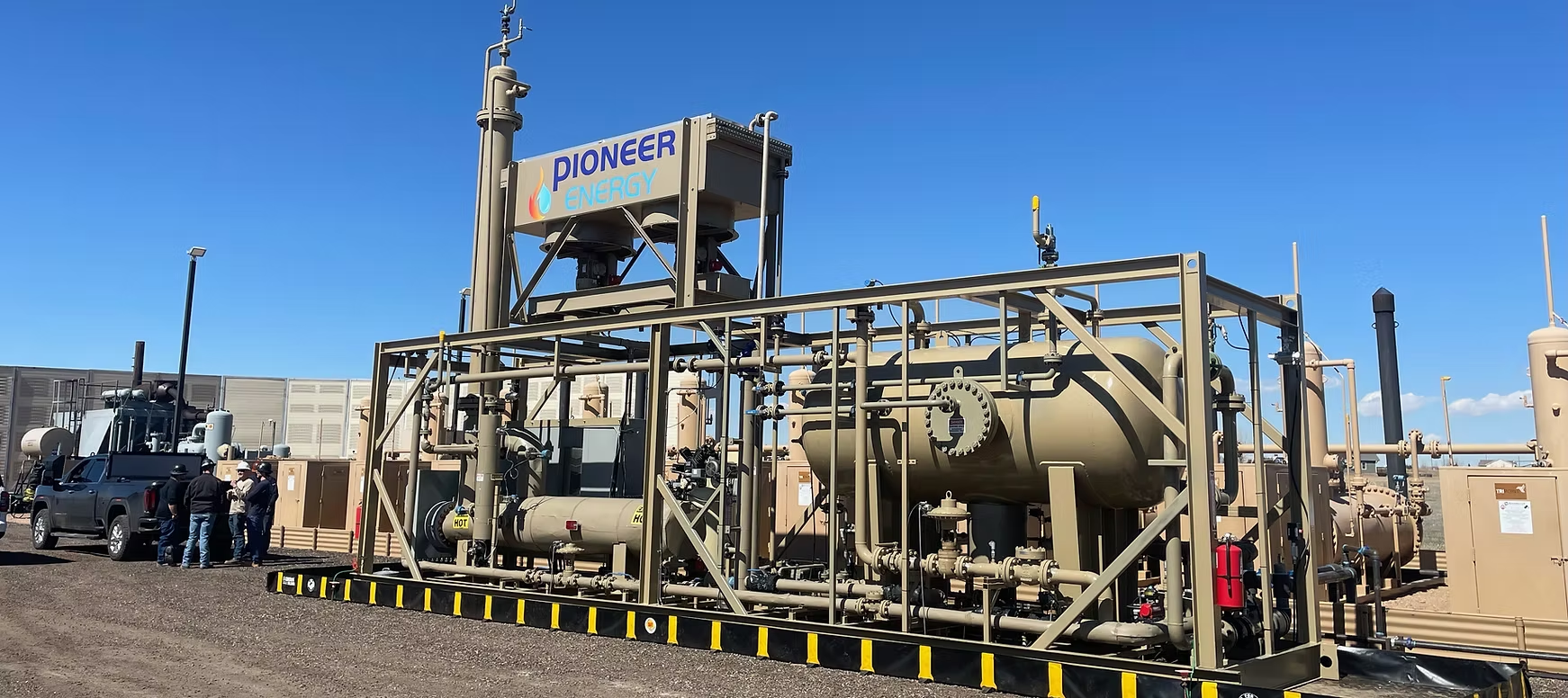
Modular gas processing describes a design philosophy where all process equipment, separators, heat exchangers, refrigeration units, pumps, controls, and piping, is pre-engineered, pre-fabricated, and pre-assembled on one or more transportable steel skids at a manufacturing facility.
The completed skid (or set of skids) is:
- Fully assembled and functionally tested at the shop under controlled conditions
- Transported to the field site by flatbed truck, rail, or barge
- Set on a prepared pad and connected to site utilities (power, gas inlet, liquid outlet)
- Commissioned and started up at the field location
Contrast this with stick-built (field-erected) permanent plants, where:
- Individual equipment items are shipped separately to the field site
- Structural steel, piping, instrumentation, and electrical work are performed by construction crews on-site
- Extended construction periods expose the project to weather, labor variability, and field conditions
- Commissioning and testing occur in the field rather than in a controlled shop environment
The Economics of Permanent Plants: Why They Made Sense Historically
Permanent, field-erected gas processing plants were the standard for decades for good reasons that were rational given the conditions of the time:
Large, long-life fields, When a field was expected to produce at full capacity for 20+ years, the capital cost of a permanent plant could be amortized over a sufficiently long period to be economical.
Limited equipment standardization, Early gas processing equipment required significant custom engineering for each application, making factory pre-fabrication impractical.
Proximity to fabrication shops, Remote fields in the pre-interstate era often meant that transporting pre-built skids was more difficult than constructing on-site.
These conditions no longer apply to most upstream oil and gas operations in 2026.
Why Shale Changed Everything
The shale revolution fundamentally altered the economics of gas processing infrastructure in three ways that favor modular systems:
Shorter Production Plateau Lives
A shale oil well’s production profile is shaped like a steep mountain: rapid ramp-up to peak, followed by aggressive initial decline, then a long, slower tail. A large shale pad may reach peak production within 3–6 months of first production and decline by 50–70% within two years.
A permanent gas processing plant designed for peak production capacity is oversized for most of its operational life. The capital deployed in excess capacity earns no return.
A modular system can be right-sized for current production, with additional modules added as pads come online or removed as production declines, deploying capital only where it is currently generating return.
Faster Pad Development Timelines
Operators drill and complete shale pads in weeks to months. The 18–30 month construction timeline for a permanent gas processing plant is often longer than the time from pad spud to first production.
Waiting for permanent infrastructure means flaring or venting gas during the period between first production and plant commissioning. This is both a commercial loss and, increasingly, a regulatory problem as flaring restrictions tighten.
An 8–16 week modular system deployment timeline fits the pace of shale development. First production and first gas capture happen close together.
Multi-Basin Operations
Modern independent oil and gas companies often operate across multiple basins and shift capital allocation between them as commodity prices, regulatory environments, and geological results evolve.
A permanent gas processing plant is stranded at its installation site. A modular system can be relocated when the production economics no longer justify its current deployment, preserving capital and deploying it where returns are highest.
The Seven Advantages of Modular Over Permanent Gas Processing
1. Deployment Speed: Weeks vs. Months
This is the single most impactful advantage in most upstream applications.
| Project Phase | Modular | Permanent Plant |
|---|---|---|
| Engineering | 2–4 weeks | 4–8 months |
| Fabrication/Construction | 6–12 weeks | 12–24 months |
| Commissioning | 1–2 weeks | 2–4 months |
| Total to first gas | 8–16 weeks | 18–30 months |
The 12–18 month lead time advantage represents months of gas capture value, avoided flaring penalty, and earlier NGL recovery revenue, all of which directly fund the modular system’s capital cost.
2. Factory Testing: Reliability from Day One
Stick-built plants are commissioned in the field where construction teams assemble and test equipment under real-world constraints, weather, incomplete punch lists, subcontractor variability.
Modular systems are fully assembled and functionally tested at the manufacturing facility before the skid ships. Every valve cycles, every instrument reads, every interlock trips, and every motor runs at the shop. The commissioning engineer arrives at the field site with a system that has already run successfully, not a collection of components being assembled for the first time.
The practical result: faster startup, fewer commissioning surprises, and higher initial reliability.
3. Relocatability: Capital That Follows Production
When a shale pad’s production declines to below the economic threshold for dedicated gas processing, a permanent plant becomes stranded infrastructure. The capital invested cannot be recovered and the ongoing maintenance cost continues.
A modular system can be:
- Redeployed to a higher-production location in the same field
- Relocated to a different basin as operator capital allocation shifts
- Reconfigured for a different application (e.g., from fuel gas conditioning to NGL recovery)
- Sold or transferred as a functioning asset
This optionality has real financial value that is difficult to quantify precisely but is consistently recognized by operators who have managed end-of-life permanent plant situations.
4. Scalability: Match Capacity to Production
A modular system architecture based on standardized building blocks allows capacity to be matched to current production rather than projected peak production.
Pioneer Energy’s approach uses standardized Pegasus units that can be paralleled to scale capacity as production grows. A single Pegasus LP handles 2 MMscfd; two units in parallel handle 4 MMscfd. As field production ramps, units are added. As it declines, units are removed and redeployed.
This is impossible with a permanent plant sized for peak production.
5. Reduced Field Construction Footprint
Permanent plant construction requires extended field crews, heavy equipment, temporary facilities, and construction management overhead for 12–18 months of site activity. This creates HSE exposure, schedule risk, and interference with production operations.
A modular system arrives site-ready. A crane sets the skid. Piping connections are made to pre-engineered tie-in points. Electrical and instrumentation connections are completed to a pre-designed interface. Site work is typically measured in days to weeks, not months.
6. Capital Efficiency at Smaller Scale
Traditional permanent plants become increasingly uneconomical below certain throughput thresholds. The overhead of custom engineering, field construction management, and site infrastructure has a minimum cost floor that may exceed the NPV of gas processing for smaller-volume opportunities.
Standardized modular systems have economics that scale down with throughput in ways that permanent plants do not. An operator capturing 300 Mscfd of associated gas that would otherwise be flared can deploy a Pegasus VC or Pegasus Mini HP at economics that make no sense for a permanent plant.
7. Lower Technical Risk
Custom-engineered permanent plants are built once. If the design does not perform to specification, field modifications are expensive and time-consuming.
Standardized modular systems are built and operated many times across multiple deployments. Process performance has been empirically validated across a range of actual field conditions. The technology risk is lower because the design is proven, not one-off.
When Permanent Plants Still Make Sense
Modular systems are not the right answer for every gas processing application. Permanent plants retain advantages in specific circumstances:
Very large throughputs, At gas volumes above 50–100 MMscfd, the economies of scale in permanent plant design typically outweigh modular advantages.
Long-term, stable infrastructure, Central processing facilities serving large, multi-operator gathering systems in mature fields with 20+ year production horizons may justify permanent construction.
Complex process integration, Where gas processing must be tightly integrated with crude oil processing, amine treating, glycol dehydration, and other processes in a fully integrated plant, permanent plant design may be required.
For the upstream applications that represent most of Pioneer Energy’s market, field gas conditioning at production sites, frac fleet fuel supply, tank vapor capture, and crude stabilization at wellhead facilities, modular systems are the superior approach across capital cost, deployment speed, flexibility, and risk.
Pioneer Energy’s Modular Architecture
Pioneer Energy was built around the modular philosophy. Every product in the Pioneer lineup is engineered from the ground up as a factory-fabricated, field-deployable skid:
Pegasus LP, up to 2 MMscfd field gas conditioning, paralleling-capable
Pegasus Dream, up to 4 MMscfd, Pioneer’s highest-capacity single skid
Pegasus VC, up to 450 Mscfd, tank vapor and low-pressure inlet
Pegasus Mini HP, up to 330 Mscfd at 800–1,200 PSI inlet pressure
VPT-500 and VPT-2500, modular crude vapor pressure treaters
Titan System, integrated VPT-2500 + Pegasus LP for crude stabilization + NGL recovery
Each system ships as a pre-tested, field-ready unit. Pioneer’s cloud-enabled controls platform provides real-time monitoring, remote diagnostics, and autonomous operation, reducing on-site labor requirements and enabling rapid response to operating condition changes.
Conclusion
The case for modular gas processing over permanent plant construction has become overwhelming for most upstream oil and gas applications. Faster deployment, factory-proven reliability, relocatability, scalable capacity, and capital efficiency that works at smaller volumes, these advantages are structural, not situational.
For operators managing the associated gas challenge across a shale development program, Pioneer Energy’s modular Pegasus and Titan systems offer the fastest path from stranded gas to productive use, whether the goal is fuel displacement, NGL recovery, pipeline injection, or on-site power generation.
Contact Pioneer Energy to discuss how modular gas processing can be deployed at your facilities.
Frequently Asked Questions
What is a modular gas processing system?
A modular gas processing system is a pre-engineered, pre-fabricated, skid-mounted gas conditioning or processing unit assembled and tested at a factory before deployment. All process equipment is pre-integrated on one or more skids, requiring minimal site work for installation.
What is the difference between modular and stick-built gas processing plants?
Stick-built plants are engineered and constructed entirely on-site from individual components. Modular systems are assembled and tested off-site in a controlled shop environment, then transported to site as complete units. Modular systems deploy faster, are less sensitive to field construction conditions, and can be relocated when production moves.
How quickly can a modular gas processing system be deployed?
Pioneer Energy’s modular systems typically deploy in 8–16 weeks from order to first gas. This compares to 18–30 months for traditional permanent gas processing plant projects, made possible by factory pre-fabrication and pre-testing of the complete skid.
Can modular gas processing equipment be relocated?
Yes. When a well or field reaches end-of-life, the modular system can be disconnected, transported, and redeployed at a new location, preserving the capital investment and avoiding the stranded asset situation that affects permanent plant investments.
Are modular gas processing systems as capable as permanent plants?
For upstream and midstream gas conditioning applications, modern modular systems match or exceed the process performance of equivalent permanent plant designs. Pioneer Energy’s systems use industrial-grade refrigeration, heat exchange, and separation technology identical in principle to permanent plant equipment, factory-tested at the skid level.
What Pioneer Energy systems exemplify the modular approach?
Pioneer Energy’s entire product line is built on the modular philosophy: the Pegasus LP, Dream, VC, and Mini HP for field gas conditioning; the VPT-500 and VPT-2500 for crude vapor pressure treating; and the integrated Titan System for combined crude stabilization and NGL recovery.